Contents
Part 1 · Understand - 1. PC + Rib Flare, Together · 2. The Anatomy: Sternum & Lower Ribs
Part 2 · The Science - 3. Wolff's Law & Why Bracing Works · 4. How Muscle Grows & Balance · 5. Why Ribcage Position Comes First · 6. Posture & the Stretched Position
Part 3 · The Framework - 7. The PC + Flare Priority Pyramid
Part 4 · Do It - 8. Self-Assessment · 9. The Foundation + Brace-Aware Plan · 10. The 16-Week Program · 11. Breathing & Posture
Bonus · Go Further - What to Expect · Common Mistakes
Reference - 12. FAQ · 13. References
How to Use This Program
If the middle of your chest pushes outward and your lower ribs flare at the bottom, this is your program. Carinatum and rib flare are different problems with different fixes - but they share a ribcage, and trained together they improve together.
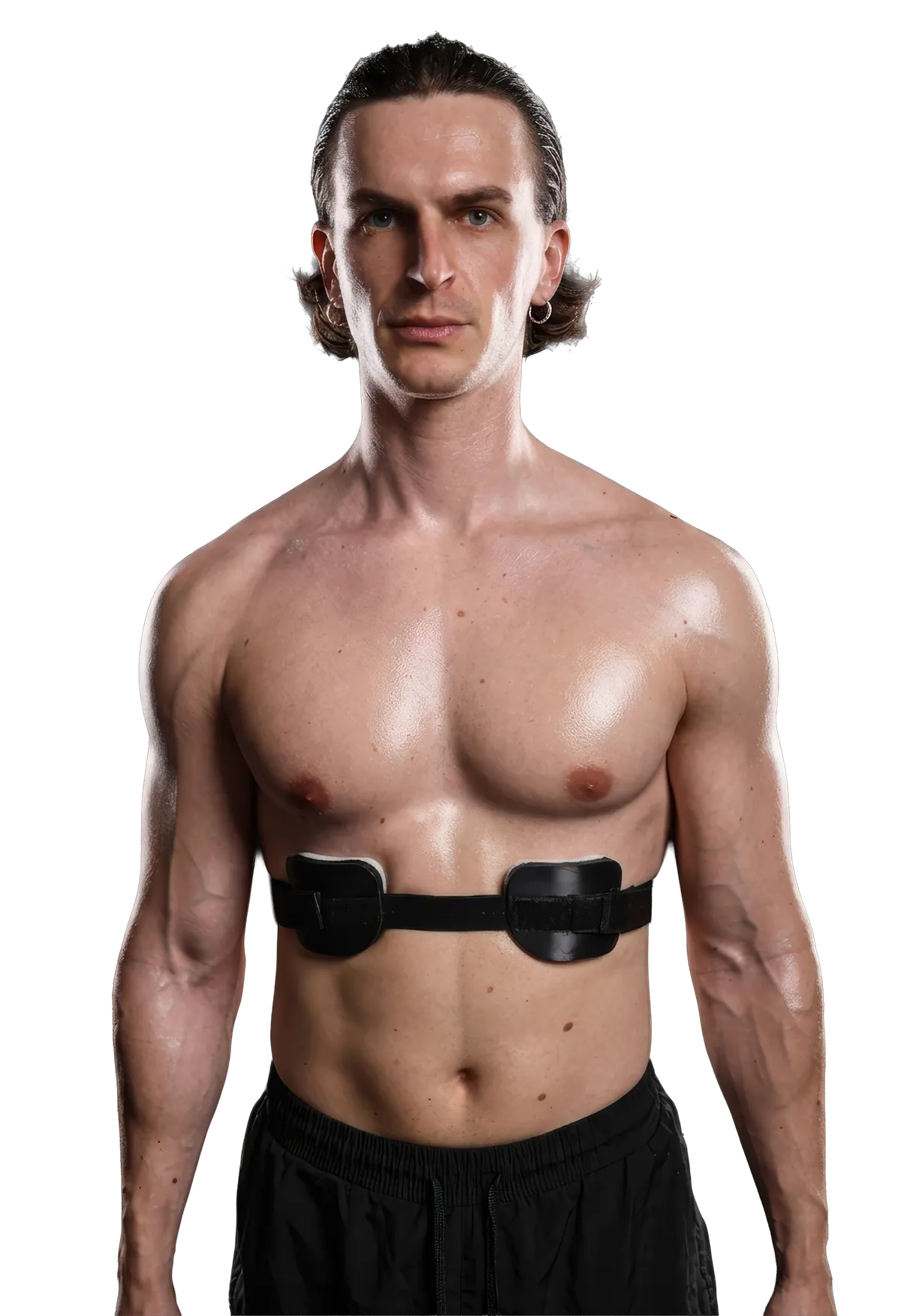
There's a dedicated Pectus Carinatum Program for the protrusion alone. This is the version for the very common case where carinatum shows up with rib flare. The honest truth up front: muscle cannot push a protruding sternum back in - the proven lever for carinatum is compression bracing on a flexible chest.3,5 Training's job here is different: improve posture so the protrusion is less prominent, build a balanced frame, bring the flared ribs down, and make your bracing work better.
For carinatum, the brace does the reshaping; training does the framing. If you're a candidate for bracing, this program is designed to run alongside it - not instead of it. Either way, the posture, breathing, and rib-position work below changes how the whole chest presents.
The four parts
- Part 1 - Understand. Why carinatum and rib flare travel together, and the anatomy of the sternum, cartilage, and the lower ribs the flare lives in.
- Part 2 - The Science. Why bone and cartilage respond to load (the basis for bracing), how muscle grows and why balance matters for a protruding chest, and why ribcage position comes first.
- Part 3 - The Framework. The PC + Flare Priority Pyramid: what to prioritize, in order.
- Part 4 - Do It. Assess yourself, learn the Foundation drills (breathing + anti-extension core) plus brace-aware training, then run the 16-week program.
Every claim that needs backing has a small lime number, like this.1 They map to the full reference list in Section 14. The bracing evidence comes from the carinatum literature3,4,5; the rib-flare and breathing work draws on chest-wall guidelines1,15 and respiratory-muscle-training research.14
Pectus Carinatum + Rib Flare, Together
Pectus carinatum (PC) - "pigeon chest" - is when the breastbone pushes outward. It's caused by overgrowth of the costal cartilage and relative undergrowth of the ribs, which levers the sternum forward.2 It usually becomes obvious during the teenage growth spurt and is the second most common chest-wall difference after excavatum.1,6
Rib flare - the lower front ribs angling and jutting outward - frequently accompanies carinatum, and it can be structural and travel with other chest-wall patterns.15 When the sternum is pushed forward and the lower ribs are flared, the whole front of the chest reads as "pushed out."
Why they show up together
Both share a forward-and-up ribcage posture. The cartilage overgrowth pushes the sternum out; the same extended, "ribs-up" position flares the lower ribs and tips the whole basket forward. So the two problems amplify each other visually - and both are influenced by the same ribcage position you can train.
- The sternum is levered forward by cartilage overgrowth - the carinatum.
- The lower ribs rotate forward and out - the flare.
- The ribcage tips back-and-up, the low back over-arches, and breathing rides high.
- Posture compensations - sometimes rounding to "hide" the chest - that we can retrain.
What training CAN and CANNOT do (no hype)
- Bring the lower ribs down - fix the flare and flatten the bottom of the chest.
- Improve posture & balance - a strong, even upper back makes the protrusion read as less prominent.
- Support your bracing - better posture and rib position make brace wear more effective and comfortable.3,4
- Build confidence and a fuller, athletic frame.
- Push the sternum back in. No muscle pulls the breastbone inward. Reshaping a protrusion comes from compression bracing on a flexible chest, or surgery.3,5
- Be replaced by over-building the chest. Piling mass onto a protruding sternum can make it more prominent - balance matters more than bench.
- Replace medical care or a guided bracing plan.
Carinatum is occasionally associated with connective-tissue or cardiac conditions, so get assessed.6 If you're bracing, follow a provider-guided plan - compliance (hours worn) is the single biggest predictor of success.4
The Anatomy: Sternum & Lower Ribs
Two things shape the front of your chest: the sternum/cartilage (which bracing reshapes) and the position of the ribcage (which training and breathing reshape). Understanding both makes the program obvious.
The protrusion: cartilage, not muscle
The forward push comes from overgrown costal cartilage levering the sternum out.2 Crucially, that cartilage is responsive tissue - under sustained, directed pressure it remodels, which is exactly why a compression brace works on a flexible, growing chest.3 Muscle sits on top of this; it can frame the chest but it can't reverse the lever.
The flare: diaphragm, abdominals, ribcage position
The lower-rib flare is governed from the inside, by the same machinery as in any rib flare:
- The diaphragm - when domed under the lower ribs, it draws them down on every exhale; when the ribcage tips back, it can't.
- The deep abdominal wall (internal obliques, transversus) - attaches to the lower ribs and pulls them down when strong and engaged.
- The serratus and upper back - position the ribcage and shoulder blades so posture is balanced.
"Stacking" the ribcage - ribs down, basket over pelvis, breathing into the back and sides - flattens the flare and improves posture. For carinatum it has a bonus: a stacked, balanced posture stops you from unconsciously thrusting the chest forward, which exaggerates the protrusion.
Wolff's Law & Why Bracing Works
Bone and cartilage are living, adapting tissues. Wolff's Law (1892) and Frost's "mechanostat" describe how they remodel when mechanical strain crosses a threshold.7,8 A pectus carinatum brace applies sustained, directed compression to the protruding cartilage - and on a flexible chest, that pressure gradually reshapes it.3
The research is clear on what makes bracing succeed: chest flexibility and patient age predict correction,5 and compliance - actually wearing it for the prescribed hours - is the single biggest determinant of results.4 Even lower-intensity plans can work if worn consistently.3 This program's job is to make that wear easier and more effective by improving the posture and rib position around the brace.
Training will not flatten the protrusion by itself. If reshaping the sternum is your goal, a guided brace plan is the proven route. Training makes the rest of the chest balanced and brings the flare down - which together make a big visual difference.
How Muscle Grows (& Why Balance Matters)
Muscle grows from mechanical tension applied through range, progressively, over time.9 Total weekly volume12 and frequency13 are the big levers, with training at longer muscle lengths offering a small hypertrophy edge.10,11
But carinatum changes the priority. Heaping size onto the chest can make a protruding sternum stand out more. So this program emphasizes the upper back, rear delts, and lats to build width and balance, trains the chest for tone and posture rather than maximum mass, and uses lower-rib and core work to flatten the bottom of the chest. The goal is a balanced, athletic frame - not a bigger bulge.
Why Ribcage Position Comes First
The flare half of your chest is mostly positional - which means it's the fastest thing to improve. Fix the position first and the bottom of your chest flattens before you've changed anything else.
When the ribcage tips back and up, the diaphragm can't park under the lower ribs, breathing rides high, and the lower ribs stay flared. Restoring the position - ribs down, diaphragm domed, breathing into the back and sides - is the first job.
Breathing is trainable
The breathing muscles respond to training like any other; respiratory-muscle training improves their strength and function.14 For us, the practical win is the full exhale: it's the action that draws the lower ribs down and teaches the ribcage a new resting position.
Anti-extension core, not crunches
The core work here is anti-extension - bracing that resists the low back arching and the ribs flaring up: dead bugs, planks with a posterior tilt, hollow holds. Mechanical tension builds that strength the same way it builds any muscle.9 It's what keeps the ribs down once you add load - and it pairs perfectly with brace wear.
Exhale fully → ribs down → feel the lower abs → keep that position → then train. For carinatum this also kills the unconscious "chest-out" posture that makes the protrusion pop.
Posture & the Stretched Position
Training a muscle in its lengthened position produces at least as much growth as full range, often with a small advantage.10,11 For carinatum we use this carefully: build the back and shoulders through full range for width and posture, and train the chest for tone without exaggerating the protrusion.
The posture goal is a tall, stacked, balanced torso - not a thrown-back, chest-forward "attention" posture (which flares ribs and pushes the sternum out) and not a rounded, hiding posture either. Right in the middle: ribs down, shoulders back and level, head over the ribcage.
The PC + Flare Priority Pyramid
For a protruding chest with flare, the order looks like this - bracing (if you're a candidate) and ribcage position do the heavy lifting; balanced training frames the result.
Self-Assessment
Three checks: the protrusion, its flexibility (the bracing predictor), and the flare.
A. Protrusion & flexibility
- In a mirror, side on: how far does the sternum push forward of the rest of the chest? Mild / moderate / pronounced.
- Flexibility test: gently press on the most prominent point. Does it move/give? A flexible chest is the best bracing candidate.5 A rigid chest needs a provider's assessment.
B. Flare check
- Stand relaxed: do the bottom front ribs jut forward past your stomach line? Lie down, arms overhead - do the lower ribs pop toward the ceiling?
- Exhale test: breathe all the way out and draw the lower ribs down. Easy = positional (great); stuck = more breathing work needed.
| Your picture | Version | Emphasis |
|---|---|---|
| Flexible protrusion, positional flare | Brace + train | Bracing is highly effective; training frames it. |
| Moderate, some rigidity | Provider-guided brace | Get a bracing assessment; train posture/flare alongside. |
| Rigid or symptomatic | Assessed first | See a specialist; train breathing/posture freely. |
The Foundation + Brace-Aware Plan
The Foundation re-positions the ribcage (fixes the flare and balances posture). The training layer builds back/posture and balanced chest tone. If you brace, this runs alongside your brace schedule.
Layer 1 - The Foundation (do first, every session)
- Setup
- On your back, feet on a wall/chair, hips & knees at 90°. Low back lightly flat.
- Do
- Inhale through the nose into the back and sides. Exhale fully through pursed lips, feel the lower ribs drop and the lower abs engage. Pause at the bottom.
- Dose
- 5 breaths × 2 sets. The rep that fixes the flare.
- Do
- Ribs down, low back glued to the floor, lower opposite arm and leg slowly without letting the ribs pop up.
- Dose
- 6–8 per side × 2.
- Do
- Stand against a wall, flatten the low back gently, ribs down, head back. Hold the balanced "stacked" position and breathe.
- Dose
- 3 × 20–30 sec. This is your reference posture.
Layer 2 - Balanced training (back-led)
- Do
- Chest on a pad so you can't arch or thrust the sternum. Build mid-back width without flaring ribs.
- Dose
- 10–12 reps × 4.
- Do
- Pull to the face, elbows high; builds the rear delts and upper back that balance the frame.
- Dose
- 15 reps × 3.
- Do
- Press for tone and posture, NOT max mass. Keep ribs down and don't let the sternum thrust forward at lockout.
- Dose
- 10–12 reps × 3. Moderate load.
The 16-Week Program
Four full-body days (every other day works perfectly), back-led, opening with the Foundation. If you brace, keep your provider's wear schedule - the training fits around it.
Goal: own the stacked posture, build back/posture base, learn the lifts.
| Exercise | Sets × reps | Notes |
|---|---|---|
| Foundation (F1–F3) | 1 round | Non-negotiable |
| Chest-supported row | 4 × 10 | No arch, no thrust |
| Lat pulldown | 3 × 10 | Width |
| Face pull | 3 × 15 | Rear delts |
| Dead bug / plank | 3 sets | Anti-extension |
| Exercise | Sets × reps | Notes |
|---|---|---|
| Foundation (F1–F3) | 1 round | |
| Incline press (moderate) | 3 × 10 | Tone, ribs down |
| Overhead press | 3 × 10 | No rib flare |
| Serratus punch | 3 × 12 | Ribcage position |
| Hanging knee raise | 3 × 10 | Anti-extension |
| Exercise | Sets × reps | Notes |
|---|---|---|
| Foundation (F1–F3) | 1 round | |
| Row variation | 3 × 12 | Back width |
| Goblet squat | 3 × 10 | Braced, ribs down |
| Push-up (ribs down) | 3 × AMRAP | Tone |
| Hollow hold | 3 sets | Anti-extension |
| Exercise | Sets × reps | Notes |
|---|---|---|
| Foundation (F1–F3) | 1 round | |
| Lat pulldown / pull-up | 4 × 10 | Width frames the protrusion |
| Rear-delt / face pull | 3 × 15 | Shoulders back & level |
| Dumbbell serratus punch | 3 × 12 | Rib-cage position |
| Reverse crunch | 3 × 12–15 | Lower abs, ribs down |
Goal: add back/posture volume and load, keep chest balanced, keep the Foundation.
Goal: peak posture & width work; Foundation stays your forever warm-up.
Goal: bodyweight + a band. Back-led, posture-first.
| Exercise | Sets × reps | Notes |
|---|---|---|
| Foundation (F1–F3) | 1 round | |
| Band row | 4 × 12 | No thrust |
| Band face pull | 3 × 15 | Rear delts |
| Dead bug + hollow | 3 sets | Anti-extension |
| Exercise | Sets × reps | Notes |
|---|---|---|
| Foundation (F1–F3) | 1 round | |
| Push-up (ribs down) | 3 × AMRAP | Tone |
| Pike press | 3 × 10 | Shoulders |
| Serratus wall slide | 3 × 10 | Position |
| Exercise | Sets × reps | Notes |
|---|---|---|
| Foundation (F1–F3) | 1 round | |
| Band row | 3 × 12 | Back width |
| Split squat | 3 × 10/side | Ribs down |
| Plank reach-out | 3 sets | Anti-extension |
| Exercise | Sets × reps | Notes |
|---|---|---|
| Foundation (F1–F3) | 1 round | |
| Band lat pulldown | 4 × 12 | Width frames the protrusion |
| Band face pull | 3 × 15 | Shoulders back & level |
| Scapular push-up (serratus) | 3 × 12 | Rib-cage position |
| Reverse crunch | 3 × 12–15 | Lower abs, ribs down |
Your week at a glance
Breathing & Posture Plan
The daily glue - and for carinatum, the habit that stops you thrusting the chest forward.
Trained breathing muscles and a practiced exhale change the resting position of the ribcage over weeks14 - and a balanced posture is what makes a protruding sternum read as less prominent.
What to Expect, Month by Month
| Window | Flare & posture | Protrusion (with bracing) |
|---|---|---|
| Month 1 | Find the stacked position; ribs come down more easily. | Skin adapts to brace; consistency building. |
| Month 2 | Flare softer at rest; posture more balanced. | Early give in flexible chests with good compliance.4 |
| Month 3 | Stacked posture becomes default; back fills in. | Measurable flattening in responsive cases.5 |
| Month 4+ | Balanced frame; protrusion reads less prominent. | Continued correction with sustained wear. |
Training timelines are reliable; bracing timelines depend on flexibility, age, and hours worn. The flare and posture improve from training alone - the protrusion needs the brace.
Common Mistakes & Troubleshooting
- Trying to "press the chest flat." No amount of bench reverses a protrusion. Brace for the sternum; train for balance.
- Over-building the chest. Big pecs on a protruding sternum can make it pop more. Lead with back and posture.
- Thrust-chest "good posture." The military "chest out" posture flares ribs and exaggerates carinatum. Aim for stacked and balanced.
- Arching the low back under load. Borrowed extension flares the ribs. Keep ribs down on every rep.
- Skipping brace hours. Compliance is the #1 predictor of bracing success.4 The training won't replace the hours.
- Ignoring the breathing. It's the fastest win for the flare and the cheapest. Do it daily.
Meditation & Anxiety
A protruding chest with flared ribs carries a real psychological weight, and managing the anxiety around it is part of the work. People with pectus report measurably higher anxiety and a more negative body image than their peers.16,17
A daily meditation practice is one of the best-evidenced, lowest-cost tools for that anxiety, supported by randomized trials and large meta-analyses.18,19,20,21,22 It won't change the shape of your chest; it changes your relationship to the worry about it. Ten minutes a day is enough to start.
I'm no meditation expert, but I practise about 10 minutes every day, and it's made a big, big difference to how I carry all of this. The app I love is Waking Up by Sam Harris, it's the easiest way I've found to actually start and stick with it. If money's tight, use its scholarship: at sign-up you can set the price to $0 and try it completely free.
How to start, 10 minutes a day
- Guided first. Don't sit in silence wondering if you're doing it right, follow a guided session. Waking Up is what I use; choose the scholarship / $0 option to try it free.
- Same time daily. 10 minutes, ideally in the morning before you reach for your phone. Consistency beats length.
- Notice, don't fight. When a thought about your chest shows up, label it and return to the breath. That's the whole rep.
Pectus patients carry a documented anxiety and body-image burden,16,17 and mindfulness meditation has solid evidence for reducing anxiety.18,20 Ten minutes a day is a real, free tool, so it earns its place beside the training.
FAQ
Can exercise flatten my carinatum? +
Do I have carinatum + rib flare, or just one? +
How important is brace compliance? +
Will big pecs help or hurt? +
I'm an adult - is bracing still worth it? +
Do I need a gym? +
Should I see a doctor first? +
References
Every lime number maps to an entry below. The carinatum/bracing literature sits alongside the chest-wall and breathing research behind the rib-flare work.
- The pectus care guidelines: best-practice consensus guidelines from the joint specialists. mrpectus research library, PMID 38964837. - Prevalence, classification, and management consensus.
- Feng J, et al. The etiology of pectus carinatum involves overgrowth of costal cartilage and undergrowth of ribs. mrpectus research library, PMID 25092085. - Cause of the protrusion.
- A less-intensive bracing plan for pectus carinatum. mrpectus research library, PMID 28196662. - Compression bracing reshapes flexible chests; lower-intensity plans can work with compliance.
- Lee RT, et al. Factors affecting patient compliance with compressive brace therapy for pectus carinatum. mrpectus research library, PMID 25164133. - Compliance is the key determinant of bracing success.
- Development of a clinical predictive score for bracing outcomes in children with pectus carinatum. mrpectus research library, PMID 41512909. - Flexibility and age predict correction.
- Pectus excavatum and carinatum in children and adolescents - what to say, what to do. mrpectus research library, PMID 28714634. - Clinical overview, associated conditions.
- Wolff J. Das Gesetz der Transformation der Knochen (The Law of Bone Remodeling). Berlin: Hirschwald; 1892. - Bone/cartilage adapts to mechanical load.
- Frost HM. Bone's mechanostat: a 2003 update. Anat Rec A. 2003;275(2):1081–1101. - Strain-threshold model of tissue adaptation.
- Schoenfeld BJ. The mechanisms of muscle hypertrophy and their application to resistance training. J Strength Cond Res. 2010;24(10):2857–2872. - Mechanical tension as the primary driver of growth.
- Pedrosa GF, et al. Partial range of motion training at long muscle lengths elicits favorable muscular adaptations. Eur J Sport Sci. 2022;22(8):1250–1260. - Lengthened-position training for hypertrophy.
- Wolf M, et al. Partial vs full range of motion resistance training: a systematic review and meta-analysis. 2023. - Advantage to training at long muscle lengths.
- Schoenfeld BJ, Ogborn D, Krieger JW. Dose-response relationship between weekly resistance training volume and increases in muscle mass. J Sports Sci. 2017;35(11):1073–1082. - More weekly sets → more growth, with diminishing returns.
- Schoenfeld BJ, Ogborn D, Krieger JW. Effects of resistance training frequency on measures of muscle hypertrophy. Sports Med. 2016;46(11):1689–1697. - Higher frequency aids accumulating quality volume.
- Illi SK, Held U, Frank I, Spengler CM. Effect of respiratory muscle training on exercise performance in healthy individuals: a systematic review and meta-analysis. Sports Med. 2012;42(8):707–724. - Respiratory-muscle training improves breathing-muscle function; supports the breathing work.
- Flaring of the ribs associated with other skeletal anomalies. mrpectus research library, PMID 14365170. - Rib flare can be structural and travel with other chest-wall/skeletal patterns.
- Surgical correction of pectus carinatum improves perceived body image, mental health and self-esteem. mrpectus research library, PMID 25783317. - Correction improves body image and mental health.
- Pectus excavatum and pectus carinatum patients suffer from lower quality of life and impaired body image. mrpectus research library, PMID 21440452. - Lower QoL and more negative body image vs peers.
- Goyal M, et al. Meditation programs for psychological stress and well-being: a systematic review and meta-analysis. JAMA Intern Med. 2014;174(3):357–368; PMID 24395196. - Mindfulness meditation programs reduce anxiety.
- Hofmann SG, et al. The effect of mindfulness-based therapy on anxiety and depression: a meta-analytic review. J Consult Clin Psychol. 2010;78(2):169–183; PMID 20350028. - Robust anxiety reduction across studies.
- Hoge EA, et al. Randomized controlled trial of mindfulness meditation for generalized anxiety disorder. J Clin Psychiatry. 2013;74(8):786–792; PMID 23541163. - RCT evidence in clinical anxiety.
- Kabat-Zinn J, et al. Effectiveness of a meditation-based stress reduction program in the treatment of anxiety disorders. Am J Psychiatry. 1992;149(7):936–943; PMID 1609875. - Early MBSR anxiety trial.
- Khoury B, et al. Mindfulness-based therapy: a comprehensive meta-analysis. Clin Psychol Rev. 2013;33(6):763–771; PMID 23796855. - Large meta-analysis supporting mindfulness for anxiety.