Contents
Part 1 · Understand - 1. What Carinatum Is · 2. Anatomy & The Strategy
Part 2 · The Science - 3. Flexibility & The Chest Wall · 4. How Muscle Grows · 5. Why Full-Body, 3×/Week · 6. The Flatten & Frame Strategy
Part 3 · The Framework - 7. The Carinatum Priority Pyramid
Part 4 · Do It - 8. Self-Assessment · 9. The Core Plan · 10. The 16-Week Program · 11. Posture & Breathing
Bonus · Go Further - What to Expect, Month by Month · Common Mistakes & Troubleshooting · 12. Where Bracing Fits
Reference - 13. FAQ · 14. References
How to Use This Program
Pectus carinatum is the opposite problem to a sunken chest - your sternum sits too far forward. The strategy is different, and most advice online gets it wrong. Give me ten minutes to explain how this actually works, and you'll stop wasting effort on the wrong things.
My name is Mihail Veleski. I've spent a decade helping people with chest-wall differences improve them without surgery. I actually have the opposite condition myself - pectus excavatum, where the chest is sunken in rather than pushed out - so I know first-hand what it's like to want to change your chest, and just how much non-surgical work can do. Carinatum ("pigeon chest") needs an honest, specific plan - because here's the truth most people won't tell you: you cannot push the bump back in with exercise. The protrusion is cartilage and bone. No press, no stretch, no "secret move" flattens it directly.
So why a training program at all? Because how prominent that bump looks is hugely changeable - and that's what you actually care about. Three levers move it:
- Build the frame around the bump. Grow the muscles beside and around the protrusion - wide lats, fuller shoulders, a developed back and arms. As everything around it gets bigger, the bump becomes one feature among many instead of the only thing the eye lands on. It looks smaller because the rest of you looks bigger.
- Carry your chest flatter (the "carriage"). "Carriage" just means how you hold your chest and ribs. Train the front-of-the-core muscles and fix your posture so your ribs and lower chest sit down, instead of puffed up and out. This alone visibly reduces how much the chest sticks out - no bracing required.
- Keep the chest wall flexible. A supple chest wall looks softer, holds better posture, and (if you ever brace) reshapes far more - flexibility is the single biggest predictor of bracing success.5 The daily mobility and breathing drills in this program (Sections 9 & 12) are built specifically to keep it that way; physiotherapy-style mobility work alongside correction is shown to help.5,3
Stop trying to "cave in" your chest. You can't, and chasing it just frustrates you. Flip the goal: build muscle all around the bump so it stands out less, carry yourself flatter, and stay flexible. That's a goal you can actually win - and the win is just as visible as if you'd pushed the bump in.
The one tool that can actually re-shape the cartilage is a compression brace - it applies steady, measured pressure that physically pushes the protruding cartilage back in over months, and it works best on flexible, growing chests.3,5 This document is the training half of the system; the last section covers where bracing fits (and the custom braces I build). Run them together for the best result.
Every claim that needs backing has a small lime number, like this.1 They map to the reference list in Section 15. Nothing here is invented and none of it is just my opinion - every recommendation is backed by published science.
What Pectus Carinatum Is
Pectus carinatum (PC) - "pigeon chest" or "keel chest" - is a chest-wall difference where the sternum and the cartilage attaching the ribs to it are pushed outward, so the middle/lower chest juts forward. It's the second most common chest-wall difference after excavatum - in most reported series it makes up roughly one in five of all pectus cases (excavatum is the other four), so it's real but not rare. It usually becomes obvious during the teenage growth spurt.1,6
The cause is the same family of problem as excavatum, just in the other direction: the costal cartilage overgrows and pushes the sternum forward, rather than letting it sink.2 You didn't cause it, and it's not a muscle imbalance you created in the gym.
The two main types
- Chondrogladiolar (most common) - the body of the sternum and lower costal cartilages protrude. This is the classic "pigeon chest," and it's almost certainly the type you have.
- Chondromanubrial (rarer) - the upper sternum protrudes while the lower part is pulled back; often stiffer and more complex.
Carinatum also frequently travels with rib flare (lower ribs popping out) and a shoulders-back, chest-puffed posture that exaggerates the protrusion. Both of those are very trainable - and a big part of this program.
Flexible vs rigid - this matters a lot
Press gently on the protrusion. Does it move/compress, or is it rigid? Flexibility is the single most important factor in how correctable a carinatum is - flexible, growing chests respond dramatically better to compression, and flexibility is a key predictor of bracing success.5 Part of this program is specifically about keeping and improving that flexibility.
You're very tall with long limbs, loose joints, and a carinatum - mention connective-tissue screening (e.g. Marfan), which is more common with chest-wall differences and changes how you should train and brace.6 Also get assessed if you have any breathing or heart symptoms (carinatum is usually less cardiopulmonary-limiting than excavatum, but get checked).
What training CAN and CANNOT do (no hype)
- Build the frame - lats, shoulders, back, arms - so the protrusion is one feature, not the focal point.
- Flatten your carriage - anterior core + posture so the chest sits down, not puffed out.
- Improve & preserve chest-wall flexibility, which helps any bracing work better.5
- Reduce associated rib flare with breathing and core work (Section 11).
- Push the bump back in. The protrusion is cartilage/bone - only a brace (in flexible/young chests) or surgery reshapes it.3,5
- Replace a brace if you want actual structural change. Training + brace is the combination.
- Work overnight. This is a months-to-years project.
Anatomy & The Strategy
If excavatum's secret is the "reverse origin" lift, carinatum's secret is flatten & frame. Once you see which muscles do those two jobs, the whole program becomes obvious.
The bump is the sternum and the overgrown costal cartilage. You can't train cartilage away - but a whole system of muscle wraps the area, and muscle and posture decide how the chest reads. Here are the players that matter for carinatum.
Frame muscles - widen everything around the bump
- Latissimus dorsi (lats). The big back muscles that flare out under the arms. Build them and your torso gets a V-taper - visually, the chest protrusion becomes proportionally smaller. The #1 frame muscle for carinatum.
- Shoulders (deltoids). Round, full delts widen the top of your frame and draw the eye outward.
- Upper back (traps, rhomboids, rear delts). Fill out the area around and behind the chest, and pull posture into balance.
- Arms. Developed arms complete the proportional picture. Not vanity - proportion is the whole strategy.
Flatten muscles - bring the chest down, not out
- Rectus abdominis & obliques. The front and side abdominal wall pulls the rib cage and lower sternum down toward the pelvis. A strong, engaged anterior core flattens the puffed-out carriage that makes carinatum look worse.
- Transversus abdominis (deep core). Wraps the trunk; helps hold the rib cage in a stacked, "ribs-down" position rather than flared up.
- The diaphragm (via breathing). Full-exhale, ribs-down breathing trains the whole canister to sit lower (Section 11) - directly fighting the puffed-chest look.
Notice what's not the priority: heavy, puffed-up chest pressing. We're not avoiding chest work out of fear - a balanced amount is fine - but the carinatum playbook is lats, shoulders, back, and anterior core, with a flatter posture. We build the frame and bring the ribs down, instead of inflating the very area that already sticks out.
Flexibility & The Chest Wall
Why does a chest wall reshape at all? Because cartilage and bone are living, adapting tissues. Bone follows Wolff's Law - it remodels in response to the mechanical loads placed on it.7 Harold Frost refined this into the mechanostat: tissue adapts when load crosses a threshold.8 A sustained, directed compressive load (a brace) is exactly such a stimulus - and it works best while the chest is still flexible and growing.3,5
Flexibility is the lever
A flexible chest wall corrects more, faster, and with less force. A rigid one resists. So one job of this program is to keep your chest wall as supple as possible through daily thoracic mobility and breathing work (Sections 9 & 12). Even if you never brace, better flexibility means better posture and a softer-looking protrusion. If you do brace, flexibility is what lets the brace do its job.5
Training itself does not apply the sustained, directed compression needed to remodel the protrusion - a brace does that.3 What training reliably delivers is flexibility, muscle, posture, and proportion. Treat structural change as the brace's job and physique/posture change as training's job. Together they're powerful; alone, each is partial.
How Muscle Actually Grows
Building the frame is the most reliable way to change how a carinatum chest looks. The science is simple enough to state in three rules.
Mechanical tension is the boss
The primary driver of muscle growth is mechanical tension - challenging muscles against meaningful resistance through a full range of motion.9 Not the pump, not soreness. Tension.
- Take sets close to failure - stop with about 0–3 reps in reserve (RIR). The hard reps are where growth lives.
- Progressively overload - add reps or weight over weeks, and write it down.
- Do enough volume - "volume" just means the total number of hard working sets you do for a muscle across a week (so 3 sets of rows on two days = 6 sets of back volume). Enough matters; endless doesn't (Section 5).12
As a beginner you have a huge advantage: "newbie gains" come fast, and your frame can change noticeably within months. Lats and shoulders especially respond quickly - and those are exactly the muscles that reframe a carinatum chest. Bring the effort; the program handles the rest.
Why Full-Body, 4× a Week
You do not need to live in the gym. Four short full-body sessions a week - or simply training every other day - is the evidence-based sweet spot, and it fits a real life.
Weekly volume is what counts
The biggest meta-analysis on the topic found a clear dose-response: more weekly sets per muscle means more growth, with benefits stacking well past 10 sets per muscle per week, into the ~10–20 range for most people.12 But within a single session, returns diminish - so the smart move is to spread your weekly volume across more days.12
Higher frequency, fresher work
Training each muscle ~2–3×/week lets you accumulate that volume with fresh, quality sets, and you practise the movements more often.13 For carinatum it also means hitting your frame muscles - lats, shoulders, back - twice or more each week. Four honest full-body days (every other day works perfectly) hits everything, leaves room to recover and live, and is forgiving if you miss one.
Don't confuse complexity with effectiveness. A simple full-body plan run hard for a year beats an elaborate split you quit in week five. The best program is the one you'll actually do.
The Flatten & Frame Strategy
This is the most carinatum-specific science in the program - how to use training to change how the chest reads, in two directions at once.
Frame: grow the lats and shoulders in their stretch
Recent research shows muscles grow best when trained in their lengthened (stretched) position - lengthened partials matched or beat full range for hypertrophy,10 and a 2023 meta-analysis confirmed an advantage to emphasizing the stretch.11 For your frame muscles, that means:
- Let the lats stretch fully at the top of every pulldown and pullover before you pull.
- Use a full range on rows - reach forward at the bottom, squeeze at the top.
- Train shoulders through a deep range too, feeling the stretch at the bottom.
The wider and fuller your back and shoulders, the smaller the protrusion looks by comparison.
Flatten: train the anterior core to bring ribs down
A puffed, ribs-up carriage makes carinatum look worse; a flat, ribs-down carriage makes it look better. The anterior core (rectus, obliques, transversus) is what pulls the rib cage down toward the pelvis. Training it - and pairing it with full-exhale breathing (Section 11) - flattens the front of the chest without you ever trying to "suck the bump in."
Bias your training to pulling and width. For every pressing movement, do at least as much (ideally more) pulling and lat work. Cue a tall spine with ribs down, not a puffed chest. On lat/back work, own the stretch at the top. That's the whole strategy in one paragraph.
The Carinatum Priority Pyramid
My framework for what to prioritize, in order. Every level matters - but they're stacked by importance. Nail the bottom before you fuss over the top.
Level 1 - Consistency, Flexibility & Effort
The foundation. Show up three days a week, do your daily mobility/breathing to keep the chest wall supple, and train each set with intent - for months. This is the only non-negotiable level.
Level 2 - Volume, Intensity & Frequency
10–20 hard sets per muscle per week, 0–3 RIR, across 3 full-body days.12,13
Level 3 - Progression
Beat your logbook - add a rep or a little weight, week over week.
Level 4 - Exercise Selection
Now it matters which exercises: bias lats, shoulders, upper back, and anterior core, with balanced (not excessive) chest work. The selection is in Sections 9, 10 and 13.
Level 5 - Rest Periods
2–3 minutes on big compounds; 60–90 seconds on isolation and core.
Level 6 - Tempo
The fine detail: control the lowering phase and own the stretch on lat and back work.
Self-Assessment
Fifteen minutes. This sets your starting point and gives you numbers to beat. Re-check every 4 weeks.
8.1 The flexibility test (most important)
Sit or stand relaxed. Put the heel of one hand on the most prominent point of the bump and press gently straight back, toward your spine (firm, not painful). Notice how much it moves:
- Flexible: it gives noticeably and springs back. Best case - an excellent candidate for bracing, and posture/training changes will show clearly.5
- Semi-rigid: some give, but firm. Still worth bracing; flexibility work matters even more.
- Rigid: little to no give. Bracing is less likely to fully correct; training focuses on frame, posture and proportion. See a specialist.
8.2 Your "how far it sticks out" number
You want one simple number you can re-measure each month. Here's the easy way:
- Lie on your back and relax your breathing.
- Lay a straight edge - a ruler, a wooden spoon, the spine of a hardcover book - flat across your chest, side to side. It will tip up and balance on the highest point of the bump, like a plank resting on a hill, with its ends lifting off the flatter chest on either side.
- With a tape measure, measure the gap between one lifted end of the straight edge and your chest underneath it. That gap is roughly how far your sternum sticks out.
- Write it down. Re-measure the same spot, the same way, once a month.
Also take front and side photos in the same light, distance and relaxed posture every month - as your frame grows, the change in proportion shows up in photos better than any single number.
8.3 Posture check (against a wall)
Stand with your back flat against a wall - heels, butt, upper back and head all touching - and relax normally. Have someone take a side-on photo, shirt off. Now tick what you notice:
- Chest puffed / ribs up - the lower front ribs lift and flare away from the wall line.
- Rib flare - the bottom edge of the rib cage pops outward.
- Shoulders pulled back & up - a stiff, "soldier" chest-out posture.
- Over-arched lower back - a big gap between your lower back and the wall.
The more boxes you tick, the more the posture & core work in this program will reduce how much the chest sticks out - because every one of those habits makes the bump look bigger than it is.
8.4 Which version?
| If you… | Run this |
|---|---|
| Have access to a gym / weights | Gym version (Section 10) |
| Train at home / just starting | Home version (bands + bodyweight) |
| Want structural change | Add the brace (Section 12) alongside either track |
The Core Carinatum Plan
The daily, carinatum-specific layer that runs alongside your training: keep the chest wall supple, and groove a flat, ribs-down carriage. Five to ten minutes, every day.
Part A - Daily flexibility (keep the chest supple)
- Do
- Lie with a foam roll across your upper-mid back, hands supporting your head. Breathe in, gently extend back over the roll, exhale. Move the roll up/down a few segments. 1–2 min.
- No foam roll?
- Use a rolled-up bath towel (roll it tight and tape it), a firm couch cushion, or simply drape your upper back backward over the armrest of a sofa. Anything that lets your upper back arch gently over a firm edge works.
- Do
- On your side, knees bent, arms together in front. Open the top arm across to the other side, following with your eyes, rotating the upper back. 6–8/side, slow.
Part B - Daily flatten (ribs-down carriage)
- Do
- Lie on your back, feet on a wall/chair, hips and knees ~90°. Exhale fully through the mouth and feel your front ribs drop toward your belt. Pause at the bottom of the exhale, breathe in quietly through the nose without letting the ribs flare. 5–8 breaths.
- Do
- On your back, arms up, knees over hips. Keep your lower back gently pressed down and ribs down as you slowly lower opposite arm and leg, then switch. 8–10/side.
They're not random - each does one of the two jobs that change a carinatum chest. A1 & A2 (mobility) keep the thoracic spine and chest wall supple, and flexibility is the strongest predictor of how well a chest corrects.5 B1 (breathing) retrains the rib cage to sit down instead of flared up - the breathing muscles adapt to training like any other.14 B2 (dead bug) builds the anterior core that holds that ribs-down position, through simple loaded, controlled movement.9 Mobility + breathing + anti-extension core is the same foundation used in physiotherapy alongside bracing.3
Do Part A + Part B every day, even on rest days. It's ten minutes. Flexibility and a ribs-down carriage are habits - and habits are what actually change how your chest looks over months.
The 16-Week Program
Four short workouts a week (every other day works perfectly), full-body, biased toward pull > push and width. You run the same four workouts - A, B, C and D - for all 16 weeks; what changes week to week is the load and reps, laid out in the Progression Map below. Every day on top, you do the short Core Plan from Section 9.
Your week at a glance
No matter what, do the Core Plan (Section 9) - daily flexibility + ribs-down breathing, ~10 minutes. On training days, do it as your warm-up before the workout. That daily habit is what actually changes your carriage; the lifting builds the frame.
| Exercise | Sets × Reps | Notes |
|---|---|---|
| Wide Lat Pulldown ★ | 4 × 10–12 | The #1 frame builder. Full stretch at top. |
| Chest-Supported Row | 3 × 10–12 | Squeeze blades down & together. |
| Cable Lat Pullover | 3 × 12–15 | Lats in deep stretch.10 |
| Lateral Raise | 3 × 12–20 | Shoulder width. |
| Goblet Squat | 3 × 8–12 | Legs; ribs down. |
| Dead Bug | 3 × 10/side | Anterior core, ribs down. |
| Exercise | Sets × Reps | Notes |
|---|---|---|
| Pull-Up / Assisted Pull-Up ★ | 4 × 6–10 | Heavy lat work for width. |
| Single-Arm DB Row | 3 × 10–12 | Back thickness, deep stretch. |
| Face Pull | 3 × 15 | Rear delts & posture. |
| Romanian Deadlift | 3 × 8–10 | Posterior chain, tall posture. |
| Reverse Crunch | 3 × 12–15 | Lower abs, ribs down. |
| Exercise | Sets × Reps | Notes |
|---|---|---|
| DB Shoulder Press ★ | 4 × 8–12 | Broaden the top of the frame. |
| Lateral Raise | 3 × 15–20 | More width. |
| Wide Cable / Machine Row | 3 × 10–12 | Keep back volume high. |
| Incline DB Press (moderate) | 2 × 10–12 | Balanced chest - not the focus. |
| Pallof Press | 3 × 10/side | Anti-extension, ribs down. |
| Hip Thrust | 3 × 10–12 | Glutes; posterior tilt. |
| Exercise | Sets × Reps | Notes |
|---|---|---|
| Deficit Push-Up ★ | 4 × AMRAP | Hands on books/blocks so the chest sinks below them. Builds the chest and the serratus anterior - an underrated frame muscle that also helps hold the ribs down. |
| Feet-Elevated Dip | 3 × 8–12 | Feet up on a bench; control the stretch at the bottom. Chest + triceps. |
| Scapular Push-Up (serratus) | 3 × 12–15 | At the top of a push-up, push the floor away and round the upper back slightly - pure serratus. |
| Wide Lat Pulldown | 3 × 10–12 | Keep the width volume up - pull still leads. |
| Lateral Raise | 3 × 15–20 | More shoulder width. |
| Dead Bug | 3 × 10/side | Anterior core, ribs down. |
| Exercise | Sets × Reps | Notes |
|---|---|---|
| Band Lat Pulldown ★ | 4 × 12–15 | The home frame builder. |
| Inverted Row (under a table) | 3 × 8–12 | Back thickness. |
| Band Lat Pullover | 3 × 12–15 | Lats in stretch.10 |
| Band Lateral Raise | 3 × 15–20 | Shoulder width. |
| Bodyweight Squat | 3 × 15–20 | Legs; ribs down. |
| Dead Bug | 3 × 10/side | Anterior core. |
| Exercise | Sets × Reps | Notes |
|---|---|---|
| Pull-Up (assisted → full) ★ | 4 × AMRAP | Best home width builder. |
| Feet-Elevated Inverted Row | 3 × 8–12 | Harder back work. |
| Band Face Pull | 3 × 15–20 | Rear delts & posture. |
| Single-Leg Romanian Deadlift | 3 × 10/side | Posterior chain. |
| Reverse Crunch | 3 × 12–15 | Lower abs, ribs down. |
| Exercise | Sets × Reps | Notes |
|---|---|---|
| Pike Push-Up ★ | 4 × 8–12 | Shoulders; broaden the top. |
| Band Lateral Raise | 3 × 15–20 | Width. |
| Wide Inverted Row | 3 × 8–12 | Back volume. |
| Incline Push-Up (moderate) | 2 × 12–15 | Balanced chest. |
| Pallof Press (band) | 3 × 10/side | Anti-extension. |
| Glute Bridge | 3 × 12–15 | Glutes; posterior tilt. |
| Exercise | Sets × Reps | Notes |
|---|---|---|
| Deficit Push-Up ★ | 4 × AMRAP | Hands on books so the chest sinks below them. Chest and serratus anterior - an underrated frame muscle that helps hold the ribs down. |
| Dip between two chairs | 3 × 8–12 | Control the stretch at the bottom. Chest + triceps. |
| Scapular Push-Up (serratus) | 3 × 12–15 | Push the floor away at the top - pure serratus. |
| Band Lat Pulldown | 3 × 12–15 | Keep width volume up - pull still leads. |
| Band Lateral Raise | 3 × 15–20 | More shoulder width. |
| Dead Bug | 3 × 10/side | Anterior core, ribs down. |
Your 16-Week Progression Map
Same four workouts every week - this table tells you what to change. Find the week, apply the sets/reps/effort to your ★ key lifts (others stay similar). "RIR" = reps in reserve (how many you leave in the tank). Beat last week's logbook whenever you can.
| Week | Phase | Key-lift sets | Reps | Effort | This week's job |
|---|---|---|---|---|---|
| 1 | A · Foundation | 2–3 | 12 | 3 RIR | Learn the movements; stay light. |
| 2 | A | 3 | 12 | 2–3 RIR | Same weight, add reps. |
| 3 | A | 3 | 10–12 | 2 RIR | Add a little weight. |
| 4 | A | 3 | 10–12 | 2 RIR | Add reps again. |
| 5 | A | 3 | 10 | 2 RIR | Heaviest of the phase. |
| 6 | B · Development | 3–4 | 10–12 | 2 RIR | +1 set on ★ lifts. |
| 7 | B | 4 | 10–12 | 1–2 RIR | Add weight. |
| 8 | B | 4 | 8–12 | 1–2 RIR | Add reps. |
| 9 | B | 4 | 8–10 | 1–2 RIR | Add weight. |
| 10 | B | 4 | 8–10 | 1 RIR | Push the reps. |
| 11 | B | 4 | 8 | 1 RIR | Peak of the phase. |
| 12 | C · Strength & Width | 4 | 6–10 | 0–2 RIR | Heavier top sets. |
| 13 | C | 4 | 6–10 | 0–2 RIR | Add weight. |
| 14 | C | 4–5 | 6–8 | 0–1 RIR | +1 set on ★ lifts. |
| 15 | C | 4–5 | 5–8 | 0–1 RIR | Peak intensity. |
| 16 | C | 4 | 6–10 | 1–2 RIR | Strong but clean. |
| 17 | Deload | 2 | 10 | 4 RIR | Easy week - half the sets. Then restart at Week 6 with heavier numbers. |
This is a multi-year build. After the deload, loop back to Phase B (Week 6) using your new, heavier baseline - and keep the daily Core Plan forever.
Posture & Breathing
The daily habit that ties it together. A flat, ribs-down, stacked posture is the fastest visible win for carinatum - it costs nothing and you can start today.
12.1 Full-exhale, ribs-down breathing
Carinatum posture tends toward a puffed, ribs-up chest. Retrain it: exhale fully and feel the front ribs drop; breathe in quietly through the nose without flaring the ribs back up. 5 minutes daily (the 90/90 drill, B1). Over weeks this becomes your default carriage.
12.2 The posture cue
All day, one cue: tall spine, ribs down, shoulders relaxed - not chest puffed. Most people with carinatum unconsciously thrust the chest up, which maximises the protrusion. Standing tall through the spine while keeping the ribs down does the opposite.
12.3 Daily routine
| When | Do | Time |
|---|---|---|
| Morning | Thoracic extension over foam roll + open book (A1–A2) | 5 min |
| Training days | Core Plan before lifting | 5 min |
| Evening | 90/90 ribs-down breathing + dead bug | 5 min |
| All day | Posture cue: tall spine, ribs down | - |
Carinatum and rib flare often travel together. The ribs-down breathing and anterior-core work here directly help both. If flare is a big part of your picture, the dedicated Rib Flare Program goes deeper on it.
What to Expect, Month by Month
Honest timelines so you don't quit early. Carinatum is a long game - but the proportional and posture wins come faster than you'd think, and they compound.
| When | What you'll likely notice |
|---|---|
| Weeks 1–4 | Posture improves fastest of anything - standing tall with ribs down already makes the bump look smaller. Strength climbs quickly (newbie gains). Flexibility work starts to loosen the chest. |
| Weeks 4–8 | Lats and shoulders start to fill in; the V-taper begins. Your lifts and pull-up numbers climb. The chest reads as part of a developing frame, not a lone bump. |
| Weeks 8–16 | Enough new width and muscle that your silhouette changes - the protrusion is proportionally smaller. Monthly photos show it. If you're bracing, structural change may be appearing too. |
| Month 4+ | The frame keeps building for years; posture is now automatic. This is where the proportional transformation really lands. Keep the daily flexibility + bracing (if applicable). |
The bump changes slowly (or only with a brace); your frame changes on a normal training timeline. So judge progress by your shoulders, lats and posture - not by staring at the protrusion. Build the frame and the bump quietly loses its starring role.
Common Mistakes & Troubleshooting
The errors that stall carinatum progress - and the fixes.
| Mistake | The fix |
|---|---|
| Making chest the priority (pressing first, heaviest) | Flip it: pull > push. Lats, back and shoulders lead; keep chest balanced and moderate so you don't emphasise the bump. |
| Avoiding chest training entirely out of fear | The opposite error - it creates imbalance. A balanced amount is fine and keeps you proportional. "Balanced chest, big back." |
| Standing chest-up / puffed to "look better" | That maximises the protrusion. Stand tall through the spine with ribs down instead - the exhale finds it. |
| Skipping the daily flexibility work | Flexibility predicts how much a brace can correct - and keeps posture changeable. Ten minutes a day is non-negotiable. |
| Carrying too much body fat to see the frame | The proportional trick needs visible muscle. Stay reasonably lean so the lats, shoulders and back you build actually show. |
| Expecting training to push the bump in | It can't - only a brace (flexible/young) or surgery reshapes cartilage. Train for the frame; brace for the structure. |
Plateaus usually mean you stopped progressing the lifts (add reps/weight), drifted off the daily flexibility, or your body fat crept up so the frame stopped showing. Check those three first. And if structural change is your goal, that's the brace's department - pair this with the bracing course.
Where Bracing Fits
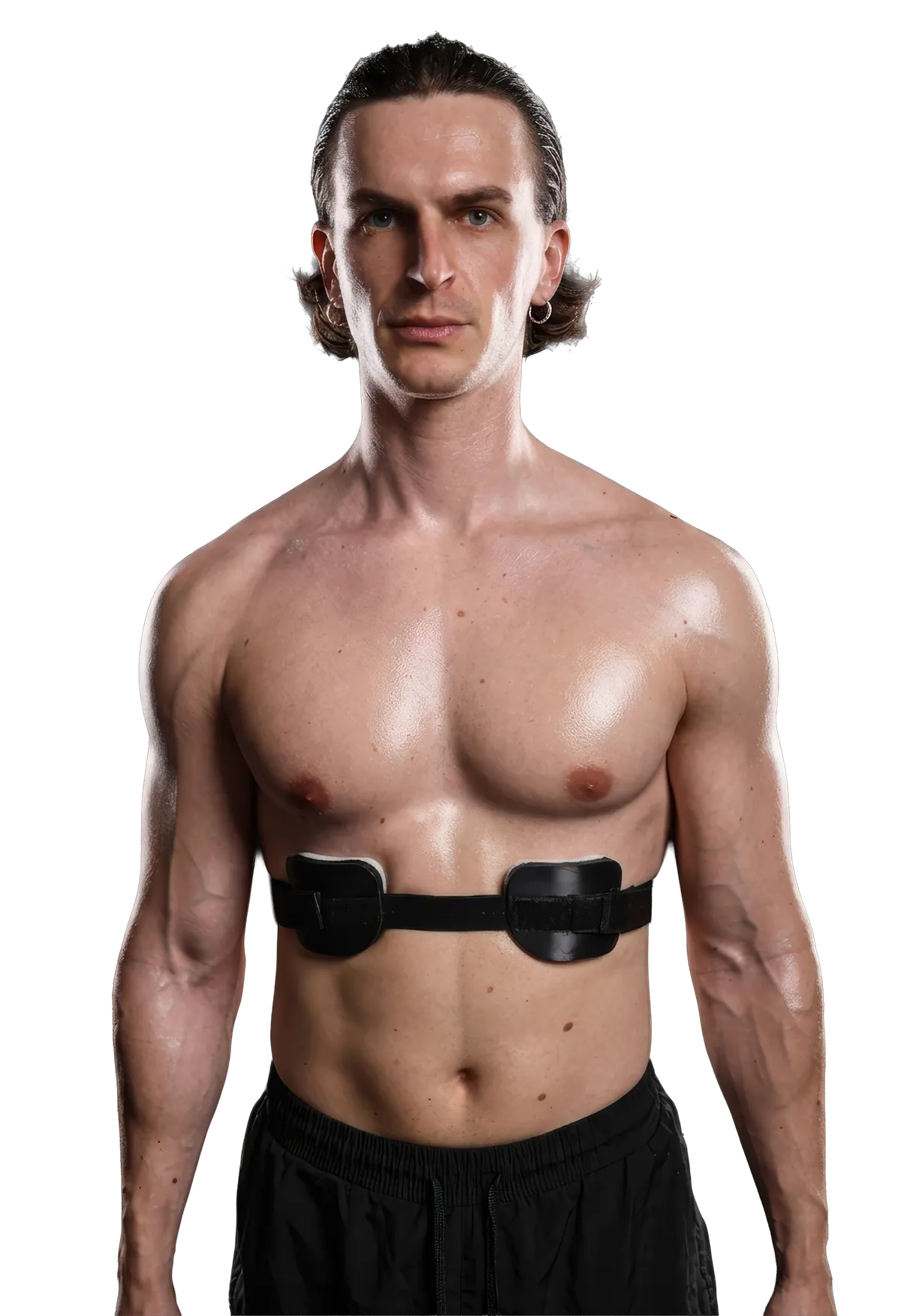
This program is the training half of the system. If you want to actually re-shape the protrusion - not just reframe it - a compression brace is the tool that does that. Here's the honest picture.
A pectus carinatum brace (a dynamic compression orthosis) applies steady, directed pressure to the protrusion. On a flexible, growing chest, that sustained load gradually remodels the cartilage - the Wolff's-Law principle from Section 3 in action.3,7 It is the most effective non-surgical way to change the actual structure.
What the research says matters most
- Flexibility & age. Flexible, younger chests correct best; rigid or fully-mature chests respond less.5
- Compliance is king. The single biggest predictor of success is simply wearing it as prescribed. Studies consistently show outcomes rise and fall with daily wear-time and adherence.4 Less-intensive plans can still work if you actually stick to them.3
- Pressure dosing. Modern braces use a measured pressure (correction vs comfort) - too little does nothing, too much causes skin issues and you stop wearing it.
Train to build the frame, flatten the carriage, and keep the chest flexible (this program). Brace to remodel the cartilage. The flexibility you build here makes the brace work better; the brace delivers the structural change training can't. For the full bracing plan - fitting, wear schedule, pressure, and timeline - see the dedicated Carinatum Bracing Course at mrpectus.com.
I build custom, 3D-scanned and 3D-printed compression braces - shaped to your exact chest and pressure-tuned to your flexibility, not a generic off-the-shelf bar. Because you bought this program, you get 15% off a custom brace if you decide to add one. Reach out through mrpectus.com and mention this program.
Bracing decisions - candidacy, pressure, and schedule - should be guided by a chest-wall specialist, especially for rigid or chondromanubrial types or if connective-tissue conditions are suspected.1,6
Meditation & Anxiety
A protruding chest carries a real psychological weight, and managing the anxiety around it is part of the work. People with pectus report measurably higher anxiety and a more negative body image than their peers.15,16
A daily meditation practice is one of the best-evidenced, lowest-cost tools for that anxiety, supported by randomized trials and large meta-analyses.17,18,19,20,21 It won't change the shape of your chest; it changes your relationship to the worry about it. Ten minutes a day is enough to start.
I'm no meditation expert, but I practise about 10 minutes every day, and it's made a big, big difference to how I carry all of this. The app I love is Waking Up by Sam Harris, it's the easiest way I've found to actually start and stick with it. If money's tight, use its scholarship: at sign-up you can set the price to $0 and try it completely free.
How to start, 10 minutes a day
- Guided first. Don't sit in silence wondering if you're doing it right, follow a guided session. Waking Up is what I use; choose the scholarship / $0 option to try it free.
- Same time daily. 10 minutes, ideally in the morning before you reach for your phone. Consistency beats length.
- Notice, don't fight. When a thought about your chest shows up, label it and return to the breath. That's the whole rep.
Pectus patients carry a documented anxiety and body-image burden,15,16 and mindfulness meditation has solid evidence for reducing anxiety.17,19 Ten minutes a day is a real, free tool, so it earns its place beside the training.
FAQ
Will building my chest make the bump worse? +
Should I avoid chest exercises completely? +
Can exercise flatten the bump on its own? +
Do I need a brace if I'm training? +
I'm an adult - is it too late? +
References
The evidence behind this program - the pectus literature plus modern sports science.
- The pectus care guidelines: best-practice consensus guidelines from the joint specialists. [mrpectus research library, PMID 38964837] - Prevalence, classification, and management consensus.
- Feng J, et al. The etiology of pectus carinatum involves overgrowth of costal cartilage and undergrowth of ribs. [mrpectus research library, PMID 25092085] - Cause of the protrusion.
- A less-intensive bracing plan for pectus carinatum. [mrpectus research library, PMID 28196662] - Compression bracing reshapes flexible chests; lower-intensity plans can work with compliance.
- Lee RT, et al. Factors affecting patient compliance with compressive brace therapy for pectus carinatum. [mrpectus research library, PMID 25164133] - Compliance is the key determinant of bracing success.
- Development of a clinical predictive score for bracing outcomes in children with pectus carinatum. [mrpectus research library, PMID 41512909] - Flexibility and age predict correction.
- Pectus excavatum and carinatum in children and adolescents - what to say, what to do. [mrpectus research library, PMID 28714634] - Clinical overview, associated conditions.
- Wolff J. Das Gesetz der Transformation der Knochen (The Law of Bone Remodeling). Berlin: Hirschwald; 1892. - Bone adapts its structure to mechanical load.
- Frost HM. Bone's mechanostat: a 2003 update. Anat Rec A. 2003;275(2):1081–1101. - Strain-threshold model of tissue adaptation.
- Schoenfeld BJ. The mechanisms of muscle hypertrophy and their application to resistance training. J Strength Cond Res. 2010;24(10):2857–2872. - Mechanical tension as the primary driver of growth.
- Pedrosa GF, et al. Partial range of motion training at long muscle lengths elicits favorable muscular adaptations. Eur J Sport Sci. 2022;22(8):1250–1260. - Lengthened-position training for hypertrophy.
- Wolf M, et al. Partial vs full range of motion resistance training: a systematic review and meta-analysis. 2023. - Advantage to training at long muscle lengths.
- Schoenfeld BJ, Ogborn D, Krieger JW. Dose-response relationship between weekly resistance training volume and increases in muscle mass. J Sports Sci. 2017;35(11):1073–1082. - More weekly sets → more growth, with diminishing returns.
- Schoenfeld BJ, Ogborn D, Krieger JW. Effects of resistance training frequency on measures of muscle hypertrophy. Sports Med. 2016;46(11):1689–1697. - Higher frequency aids accumulating quality volume.
- Illi SK, Held U, Frank I, Spengler CM. Effect of respiratory muscle training on exercise performance in healthy individuals: a systematic review and meta-analysis. Sports Med. 2012;42(8):707–724. - The breathing muscles respond to training; supports the ribs-down breathing work.
- Surgical correction of pectus carinatum improves perceived body image, mental health and self-esteem. mrpectus research library, PMID 25783317. - Correction improves body image and mental health.
- Pectus excavatum and pectus carinatum patients suffer from lower quality of life and impaired body image. mrpectus research library, PMID 21440452. - Lower QoL and more negative body image vs peers.
- Goyal M, et al. Meditation programs for psychological stress and well-being: a systematic review and meta-analysis. JAMA Intern Med. 2014;174(3):357–368; PMID 24395196. - Mindfulness meditation programs reduce anxiety.
- Hofmann SG, et al. The effect of mindfulness-based therapy on anxiety and depression: a meta-analytic review. J Consult Clin Psychol. 2010;78(2):169–183; PMID 20350028. - Robust anxiety reduction across studies.
- Hoge EA, et al. Randomized controlled trial of mindfulness meditation for generalized anxiety disorder. J Clin Psychiatry. 2013;74(8):786–792; PMID 23541163. - RCT evidence in clinical anxiety.
- Kabat-Zinn J, et al. Effectiveness of a meditation-based stress reduction program in the treatment of anxiety disorders. Am J Psychiatry. 1992;149(7):936–943; PMID 1609875. - Early MBSR anxiety trial.
- Khoury B, et al. Mindfulness-based therapy: a comprehensive meta-analysis. Clin Psychol Rev. 2013;33(6):763–771; PMID 23796855. - Large meta-analysis supporting mindfulness for anxiety.
Several citations point to abstracts in the mrpectus research library (paywalled full texts); author/title/year/PMID are given so you can find them. Training reshapes muscle, posture, flexibility and proportion - bracing reshapes the cartilage in flexible, growing chests. This program is honest about that division of labour throughout.
© mrpectus · The Pectus Carinatum Program v1.0 · Mihail Veleski · For education, not medical advice.