Read the full plan free
Enter your name and email to unlock the complete Pectus Excavatum plan right here on this page — and get a copy sent to your inbox. No spam, ever.
- Why a flexible chest can be lifted without surgery
- What the research actually shows about who succeeds
- The 3-phase protocol, start the foundation tonight, no equipment
- Vacuum bell timing, suction & progression done right
- Honest expectations and a realistic timeline
Contents
Start Here — How to Use This Plan · Is It Right For You?
Part 1 · Understand — 1. What Pectus Excavatum Is · 2. Why It Can Be Corrected
Part 2 · The Science — 3. What the Evidence Shows · 4. The Four Factors
Part 3 · The Plan — 5. Phase 1 · Foundation · 6. Phase 2 · Remodeling · 7. Phase 3 · Lock It In
Part 4 · Start — 8. Start Tonight · 9. Honest Expectations
Reference — 10. FAQ · 11. References
How to Use This Plan
This is the same foundation I give paying clients, written out in full and free. It won't replace a tailored program or 1-on-1 coaching, but it will tell you the truth about what non-surgical correction can do, who it works for, and exactly how to start, tonight, before you own a single piece of equipment.
The core idea is simple: in most younger people the chest wall is still flexible, and flexible cartilage can be re-shaped by sustained external force, the same principle behind braces on teeth. The vacuum bell does the lifting; breathing and posture decide whether the new position holds. Get the order right and you give yourself the best shot the evidence allows.
Read it top to bottom once, then come back to Part 3 as your working protocol. Where I'm reasoning from the strongest data we have, I cite it. Where non-surgical correction has real limits, I say so plainly, because knowing whether you're a good candidate is more useful than false confidence.
Two recent vacuum-bell studies anchor everything here: a 278-patient single-center review1 and a compliance study that pinned weekly wear hours as the strongest predictor of success.2 The protocol is the practical translation of those findings.
Is It Right For You?
Non-surgical correction isn't for everyone, and pretending otherwise wastes your time. It works best on a flexible chest in a younger person who will show up daily. The further you are from that profile, the more partial the result, and for a small group, surgery remains the better call.
- The chest wall still moves under pressure
- Mild to moderate starting depth
- Younger, more pliable cartilage
- Willing to commit daily for months
- A rigid or stiffened chest wall
- A very deep or severe defect
- Cardiac, lung, or connective-tissue symptoms
- Cartilage that has hardened with age
If you're in the left column, this plan is exactly for you. If you're in the right column, you can still benefit, but get assessed first, and treat surgery as a valid option rather than a failure.
What Pectus Excavatum Is
Pectus excavatum is the most common congenital chest-wall deformity. The breastbone and the cartilage joining it to the ribs grow inward, sinking the center of the chest. The key fact for treatment is this: in most younger people the chest wall is still flexible, and flexible cartilage can be gradually re-shaped by sustained external force, the same principle behind braces on teeth.
It ranges from a barely-visible dip to a deep hollow, and it's mostly cosmetic in mild cases but can affect heart and lung mechanics when severe. That severity-and-flexibility spectrum is exactly why a one-size answer doesn't exist, and why assessing your own chest comes before any protocol.
Why It Can Be Corrected Without Surgery
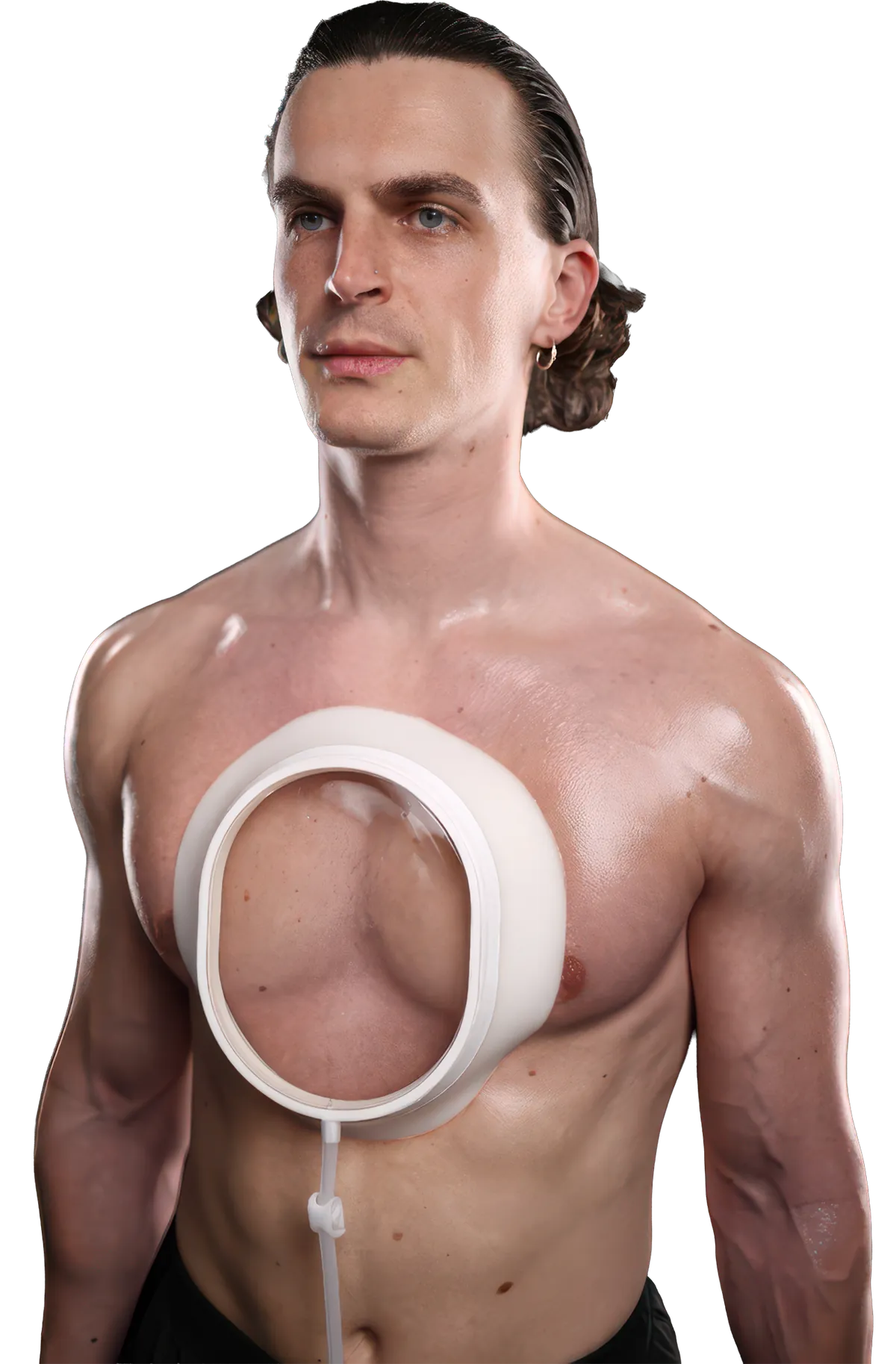
Surgery (the Nuss procedure) forces the sternum forward with a metal bar. Non-surgical correction does the same thing slowly, from the outside, using a vacuum bell, a suction cup that lifts the sternum, combined with breathing and posture work that keep the new position. Because cartilage remodels under repeated low load, consistent daily lift over months can produce a lasting change in a flexible chest.
Think of it as orthodontics for the chest: light, sustained force applied for enough hours, over enough months, gradually moves what looks fixed. The device supplies the force; your consistency supplies the time, and time on the chest is what the data says matters most.
What the Evidence Shows
Two studies do most of the heavy lifting here, and read together they more or less write the plan for you.
In a review of 278 vacuum-bell patients, chest-wall flexibility and a milder starting depth were the strongest predictors of an excellent correction, and only 15.5% went on to surgery, none of them from the group that achieved an excellent result.1
A second study compared compliant patients (≈28 hours/week) to non-compliant ones: the compliant group corrected nearly twice as much (28% vs 16%), and weekly hours was the single strongest predictor of success. Their conclusion, for a highly compliant patient, therapy "can be effective regardless of age or severity."2
Read those two findings together and the plan writes itself: start while the chest is flexible, and show up every day.
And it isn't just those two. A 2025 systematic review of 20 vacuum-bell studies3 and a 240-patient prospective cohort4 reach the same conclusion, and single-center series from Argentina,5 the United States,6 Canada,7 and Switzerland8 all report real depth correction in compliant, flexible-chested patients, with the bell also thinning the chest-wall fat pad in younger users.10
The mechanism holds up under scrutiny: imaging shows the bell measurably changes thoracic shape,9 reviews of non-surgical chest-wall care describe the same flexibility-dependent remodeling,11,12 newer work pairs the bell with 3D scanning to track it,14 and the immediate sternal-lift effect is visible even after short use.15 Current multi-society guidelines now list the vacuum bell as first-line non-surgical care for the right patient.13
The Four Factors That Decide Your Result
- Chest wall flexibility: the biggest predictor. The more your sternum moves under pressure, the more it can be re-shaped.
- Age: younger, more pliable chests respond fastest, but compliance can offset this.
- Starting depth: milder defects reach "excellent" more often, but deeper chests still improve.
- Compliance: the one you fully control, and the strongest lever in the data. Hours per week is what moves the number.
Three of those four are fixed the day you start. The fourth, compliance, is entirely yours, and it's the one the data says matters most. Don't agonize over the factors you can't change; pour everything into the hours, because that's the lever with your hand on it.
Phase 1 · Foundation
Before any device, you train the two things that decide whether a lift holds: how you breathe and how you stand.
- Diaphragmatic breathing: 5 minutes, twice a day. Breathe into the lower ribs and belly, not the upper chest, expanding the chest from the inside.
- Posture reset: thoracic extension over a rolled towel, plus shoulder-blade retractions, to stop the rounded posture that deepens the hollow.
- Baseline measurement + photos: depth at the deepest point and a front/side photo. The mirror lies; the ruler doesn't.
Phase 2 · Remodeling
This is the engine of correction. The rule is consistency beats intensity, and your skin sets the pace.
- Week 1: 2 sessions/day, 10–15 min, at a suction you can comfortably hold. Skin should go pink, not purple.
- Week 2: 2 sessions/day, 15–20 min. Add suction only once your skin recovers cleanly within an hour.
- Weeks 3+: build toward the ~28 hours/week the research links to the best results2: one session after a warm shower, when the chest is most mobile.
Pair every session with diaphragmatic breathing, inhale into the lift, to add a gentle internal stretch.
Pink skin that fades within an hour is normal; purple skin, broken skin, blistering, or numbness is not, back off the suction and the duration. The vacuum bell is a sustained-load tool, not a max-pressure one. Stop and get checked if you feel chest pain, dizziness, or shortness of breath during use.
Phase 3 · Lock It In
The bell does the lifting; muscle and posture decide whether it holds. As the depth improves, add chest-opening and upper-back strength work so the corrected shape becomes your resting position, not something you have to hold.
- Upper-back & postural strength: rows and scapular work to pull the shoulders back and keep the chest open.
- Chest-opening mobility: keep the thoracic spine extending so the sternum has room to sit forward.
- Maintenance bell sessions: taper frequency once depth stabilizes, holding the gain rather than chasing more.
Start Tonight (No Equipment Needed)
You don't need to wait for a vacuum bell to arrive. The foundation that makes the bell work is free, and you can begin it right now.
- Take a baseline side-profile photo and measure the deepest point of the hollow.
- Do 5 minutes of diaphragmatic breathing, expanding the lower ribs.
- Spend 2 minutes in thoracic extension over a rolled towel.
- Set a daily two-session reminder, you're building the habit before the bell arrives.
This free plan is the foundation. The full Pectus Excavatum Course turns it into a session-by-session vacuum-bell protocol with video coaching and progress tracking, and the deep-dive Vacuum Bell Guide covers every number and threshold. Want a plan built around your exact chest? Work with me 1-on-1.
Honest Expectations
- The chest is still flexible
- You start younger
- You stay consistent every day
- The chest is rigid or stiffened
- The defect is very severe
- Cartilage has hardened with age
A very rigid or severe chest, or an adult whose cartilage has stiffened, may see partial improvement rather than full correction, and surgery remains a valid option. Assess your flexibility and severity first, then commit fully to the protocol if you're a good candidate.
FAQ
How long until I see a change?+
What's the single most important thing?+
Am I too old for this to work?+
Will I still need surgery?+
Can I start before I own a vacuum bell?+
References
- Aughtman et al. (2025). Vacuum Bell Therapy for Pectus Excavatum: Long-term Experience at a Single Center. J Pediatr Surg. PMID 39488480
- Koo et al. (2025). Optimizing Efficacy of Vacuum Bell Therapy for Pectus Excavatum: Compliance is Key. J Surg Res. PMID 40088797
- Khalifa et al. (2025). Assessing the probability of success with vacuum bell therapy in pediatric patients with pectus excavatum: a systematic review. Pediatr Surg Int. PMID 41160133
- AlShammari et al. (2026). Prospective evaluation and successful outcomes using vacuum bell therapy for pectus excavatum: analysis of a prospective cohort of 240 patients. J Thorac Cardiovasc Surg. PMID 41198019
- Toselli et al. (2022). Determinants of success associated with vacuum bell treatment of pectus excavatum. J Pediatr Surg. PMID 35525808
- Obermeyer et al. (2018). Nonoperative management of pectus excavatum with vacuum bell therapy: a single center study. J Pediatr Surg. PMID 29606411
- St-Louis et al. (2019). Vacuum bell treatment of pectus excavatum: an early North American experience. J Pediatr Surg. PMID 30414687
- Haecker (2011). The vacuum bell for conservative treatment of pectus excavatum: the Basle experience. Pediatr Surg Int. PMID 21240610
- van Schuppen et al. (2018). Impact of vacuum bell on thoracic shape and cardiac function in pectus excavatum. J Cardiovasc Comput Tomogr. PMID 30057218
- Furuta et al. (2020). The vacuum treatment for pectus excavatum thickened subcutaneous fat of the chest wall and is effective in preteenagers. Pediatr Surg Int. PMID 33125551
- Kwong & Gulack (2024). Non-surgical approaches to the management of chest wall deformities. Semin Pediatr Surg. PMID 38219537
- Haecker (2018). Nonsurgical treatment of chest wall deformities: contradiction or complement? Eur J Pediatr Surg. PMID 30103239
- Dunning et al. (2024). The pectus care guidelines: best-practice consensus guidelines from the joint specialist societies (SCTS/MF/CWIG/BOA/BAPS). Eur J Cardiothorac Surg. PMID 38964837
- Gao et al. (2020). Noninvasive treatment of pectus excavatum with a vacuum bell combined with a three-dimensional scanner. Pediatr Surg Int. PMID 32789545
- Togoro et al. (2018). The vacuum bell device as a sternal lifter: an immediate effect even with a short time use. J Pediatr Surg. PMID 28495420
This plan translates the vacuum-bell literature into a practical protocol and is honest about its limits, flexibility and severity cap what non-surgical correction can achieve, and surgery remains appropriate for some. Education only, not a substitute for personalized medical care.
People who chose the non-surgical path
Coached one on one since 2015, with the timelines and the numbers they actually logged.
“I came across your blog about a year ago and I just want to say how much you've changed my life for the better. I thought it was going to be another average article, but the tips you gave were things I hadn't heard of before. Now I've improved so much and im more confident then ever.”
“spent two years researching surgery before i found this. six months in and i wish id found it sooner. the progress photos dont lie”