If you’ve been told to “pull your ribs down” or given a list of core exercises for your rib flare, you’ve received advice that misses the mechanism entirely.
Rib flare doesn’t start with weak core muscles. It starts with where your diaphragm sits.
The anatomy that most advice ignores
The lower ribs — the floating ribs and the costal margin — are not held in position by your abs. They’re held in position by the resting position of your diaphragm.
The diaphragm attaches to the lower ribcage. Its zone of apposition — the area where it sits against the inner surface of the lower ribs — directly influences where those ribs sit at rest. When you breathe predominantly through your chest (the apical or chest-dominant breathing pattern), the diaphragm operates in a shortened, elevated position. The lower ribs, following the pull of the elevated diaphragm, flare outward and upward.
This happens approximately 20,000 times per day — every breath you take.
No amount of planks or dead bugs addresses this mechanism. The rib cage is being repositioned continuously by the breathing pattern, reinforcing the flared position with every breath.
Why posture cues don’t work
“Ribs down” is a cue that makes anatomical sense but behavioural sense zero. You can consciously pull your ribs down during an exercise. The moment you stop thinking about it, your resting breathing pattern repositions them. And your resting breathing pattern runs for 20,000 repetitions before you go to bed.
The same logic applies to postural correction through cuing. You can temporarily change rib position through conscious effort. You cannot hold conscious effort through sleep, work, driving, and everything else that constitutes your day.
Lasting rib position change requires changing the habitual resting position of the diaphragm. That means changing the breathing pattern — not as a cue, but as a deeply ingrained motor pattern.
The breathing pattern that changes rib position
The mechanism is established in the physiotherapy and respiratory medicine literature. The Postural Restoration Institute (PRI) and Dynamic Neuromuscular Stabilisation (DNS) approaches have both documented the relationship between respiratory mechanics and thoracic shape.
The breathing pattern that addresses rib flare:
Posterior-lateral rib expansion. Rather than the chest rising and the belly distending (the two most common compensatory patterns), the breath expands the lower ribcage posteriorly and laterally. This repositions the zone of apposition of the diaphragm — pulling it toward a more depressed, caudal position that allows the lower ribs to descend.
Exhale-first approach. Complete exhalation before the inhale — reaching the point of maximum exhalation — allows the diaphragm to reset from a more depressed position on the next inhale. This is the reset point for the breathing pattern.
Frequency over duration. Five minutes of correct breathing mechanics performed 4-5 times daily produces more lasting pattern change than one 30-minute breathing session. The nervous system learns through repetition and frequency.
Why core training alone makes it worse
Heavy loaded core training — particularly exercises that create high intra-abdominal pressure like loaded squats, deadlifts, and heavy compound movements — in the context of an elevated diaphragm position actively reinforces the flared rib position.
The pressure system of the trunk requires a correctly positioned diaphragm to function as intended. When the diaphragm is in an elevated position, increased intra-abdominal pressure from loaded movement drives the lower ribs further outward. You are strengthening the compensation, not correcting it.
This doesn’t mean avoiding strength training. It means establishing correct rib mechanics before loading heavy, and using the specific core patterns that support rib closure rather than rib flare.
The correct sequence
Rib flare correction follows a specific sequence. Skipping steps compounds the problem.
-
Breathing mechanics first. Posterior-lateral expansion, diaphragm repositioning, exhale-first reset. This is the foundation that everything else is built on.
-
Lateral thoracic mobility. The lower ribs cannot descend if the thoracic cage is stiff. Lateral rib mobilisation, intercostal stretching, and thoracic rotation work create the mechanical space for rib closure.
-
Core activation in the corrected position. Transverse abdominis activation, oblique patterns, and deep core work — performed with the ribs in a corrected position. This builds the strength to maintain the position rather than return to the habitual flare.
-
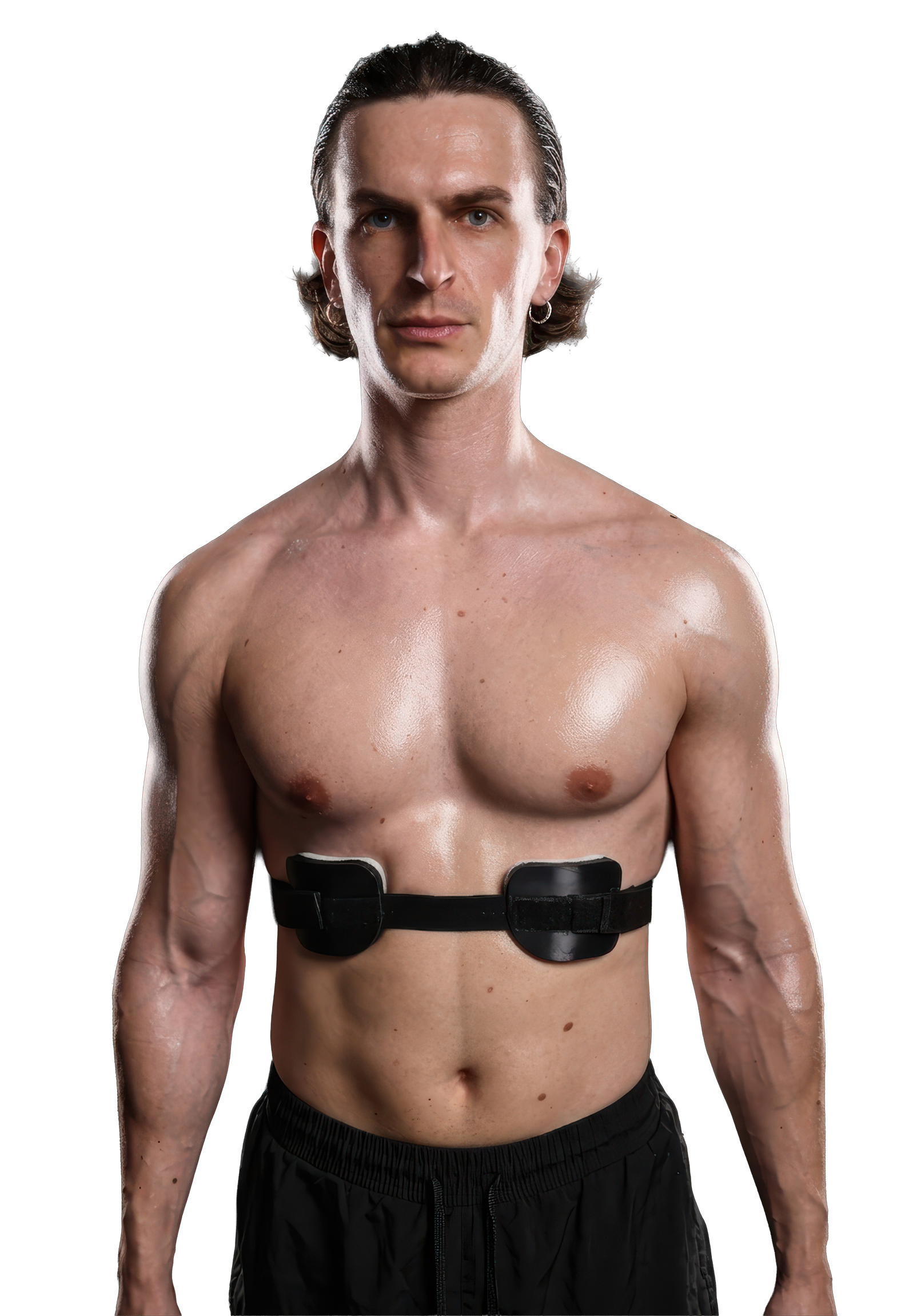
Compression bracing. If using a rib flare brace, it is introduced here — after the breathing mechanics work has begun repositioning the ribs. Compression applied to an uncorrected breathing pattern produces compliance problems without producing structural change.
-
Loaded progression. Returning to heavy compound movements with rib mechanics maintained through loading. This is not the starting point; it is the goal.
The timeline expectation
Breathing pattern retraining produces measurable changes in rib position within 6-12 weeks of consistent practice. This is shorter than most people expect — because the mechanism is responsive once you’re addressing it correctly.
Visible structural change — reduction in the subcostal angle that other people notice — typically takes 4-8 months of consistent practice in compliant cases.
The retraining needs to happen before, not after, you try to correct the shape. The shape is downstream of the breathing pattern. Fix the breathing pattern, and the shape follows.
I had pectus excavatum. I corrected it non-surgically. For the past decade I've worked with over 1,000 people navigating pectus correction. These articles are built from that experience - not adapted from somewhere else.
Full story →This article is for educational purposes only and does not constitute medical advice. Always consult a qualified healthcare professional before starting any treatment protocol. View full disclaimer →