Contents
Start Here — How to Use This Guide · Why Most Bracing Fails
Part 1 · Understand — 1. What the Brace Does · 2. POC & POT in PSI
Part 2 · The Science — 3. What the Research Shows · 4. Hours: The Real Debate · 5. Candidate + Predictive Score
Part 3 · The Framework — 6. The Carinatum Pyramid
Part 4 · Do It — 7. First Fitting & Your POC · 8. The Two Phases · 9. Compliance: Sticking With It · 10. Skin & Side Effects · 11. Exercises · 12. Caring for Your Brace · 13. Tracking & Confidence · 14. Long-Term & Recurrence
Reference — 15. FAQ · 16. References
How to Use This Guide
Of the three pectus conditions, carinatum - the protruding "pigeon" chest - responds best to non-surgical correction, and the evidence for it is the strongest of any pectus brace or device. The catch: it only works if you understand two pressure numbers and follow one schedule. This guide makes both simple, and backs every claim with a study.
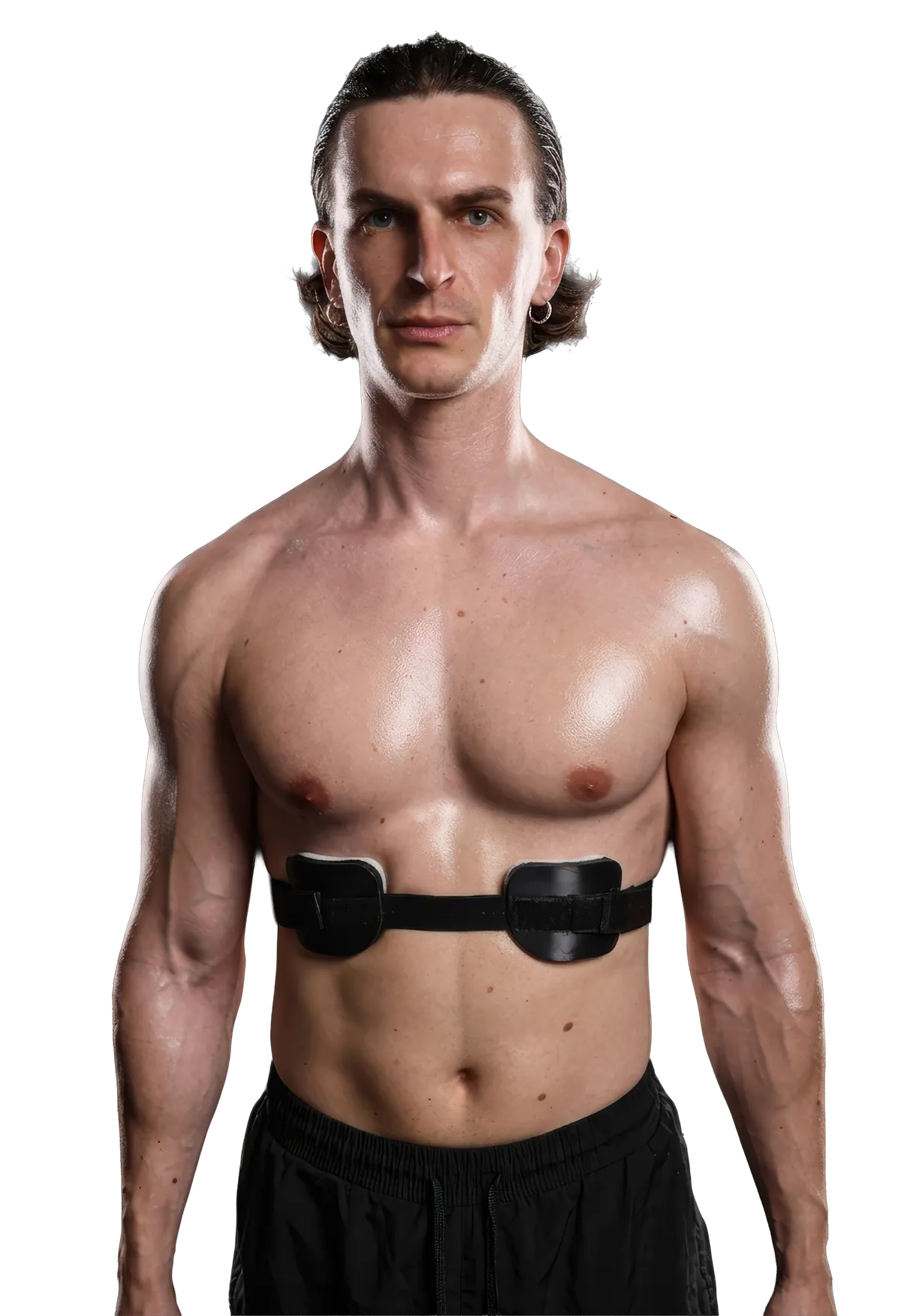
A dynamic compression brace is orthodontics for your chest. Instead of pulling a sunken chest out (the vacuum bell), it gently pushes a protruding chest in with a measured force. Because the costal cartilage that bows the chest outward is pliable - especially in teenagers - it remodels under steady pressure over months.16 Success rates in modern series run high: 76% in one cohort,1 88-92% in others.6,10
Everything here is built as a hierarchy of importance - the things that decide your result first, the fine-tuning last. And where a tip has no supporting study (skin-care routine, device care), I label it clearly as practical guidance rather than dressing it up as science.
The brace doesn't correct your chest - consistent hours under the right pressure correct your chest. The brace is just the tool that delivers them. A perfect brace worn four hours a day loses to a basic brace worn through the day, every time.
Every claim that needs backing has a lime number1 - tap it for the source (full list in Section 16). Amber "Practical guidance" boxes flag the few tips that are experience-based with no dedicated trial.
Why Most Bracing Fails
When bracing fails, it's almost never the brace - the success rates are too high for that.1,6,10 It's one of three avoidable mistakes:
- Not enough wear time. Successful patients wear it around 14-15 hours a day in the corrective phase, and wearing it >12 hours/day predicts success.1 Four hours a day puts you outside the group that wins.
- Wrong pressure. Too little and nothing remodels; too much and you can't tolerate it, so you stop. There's a correct window, and it has a name: POC and POT.6
- Quitting before it's locked in. A patient who stopped early saw the deformity rebound by 25% within six months.21 The maintenance phase is part of the treatment, not a bonus.
A flexible teenager who commits to the hours has excellent odds. An older adult with a rigid, long-standing protrusion can still improve, but more slowly and less completely - and if your chest needs very high pressure to correct, bracing may not be the right tool at all (Chapter 2). This guide tells you which case you're in.
What the Brace Actually Does
Pectus carinatum is the opposite of excavatum: the sternum and adjoining cartilage push outward. The root cause is now well documented - a 3D-CT study comparing patients to controls found the costal cartilage is overgrown (too long) while the ribs are relatively short, and that mismatch bows the chest forward.16 The good news hidden in that finding: cartilage is pliable, and pliable tissue remodels under steady pressure.
A "dynamic" compression brace lets you measure and tune the force it applies, rather than just cinching it tight. That measurability is exactly why modern braces outperform the old rigid ones - it lets you sit in the effective window instead of guessing.6
POC & POT - The Two Numbers That Matter
This is the concept that separates people who succeed from people who suffer. Dynamic compression bracing, pioneered by Martinez-Ferro, is built around two pressures the brace itself measures, in PSI.6
- POC - Pressure of Correction (also called PIC, pressure of initial correction). The pressure at which your chest visibly flattens. It's a property of your chest - flexible chests have a low POC, rigid ones high. In real cohorts the average is about 4-6.5 PSI, and it tends to rise with age.7,22
- POT - Pressure of Treatment. The pressure you actually wear all day - set below your POC: enough to remodel, low enough to tolerate for 12+ hours and keep the skin healthy.
Martinez-Ferro's foundational work set the safety rails: starting below ~2.5 PSI avoids skin lesions, while a chest needing more than ~7.5 PSI to correct is too rigid for bracing and should be considered for surgery instead.6 Other centers use ~10 PSI as the cutoff.10 And pressure predicts effort: each 1-PSI increase in correction pressure adds roughly 3.5 months to treatment.9 Lower POC = easier, faster correction.
Measure your POC honestly and set POT where you can forget the brace is on. Comfort isn't weakness here - it's the strategy. The brace that disappears into your day is the one that gets the hours that change your chest.
What the Research Actually Shows
Carinatum bracing has the strongest evidence base of any non-surgical pectus treatment.
| Finding | Number | Source |
|---|---|---|
| Treatment success | 76% (18% partial, 6% minimal) | Kahraman & Yüksel, 2025 (n=87) |
| Good/excellent result | 88.4% | Martinez-Ferro, 2008 (n=112) |
| Daily wear (successful) | 14.5 ± 2.8 hours | Kahraman & Yüksel, 2025 |
| Haller index | 2.20 → 2.59 at 6 months | Moon, 2019 (n=320) |
| Sternal-rotation reduction | 33-44% (compliant) | Egan, 2000 |
| Recurrence (large review) | 2.6% | de Beer, 2018 (n=1185) |
Two findings should run your entire plan: (1) hours win - successful patients wear it ~14-15 h/day and >12 h/day predicts success;1 and (2) stopping early costs you - a non-compliant patient regained ~25% of the deformity within six months.21 Hours build the result; consistency keeps it.
Hours - The Real Debate
"How many hours a day?" is the most argued question in carinatum bracing - and the honest answer is more interesting than a single number.
Some centers run an intensive protocol: ~20-23 hours/day in a short corrective phase, then dropping to ~8-12 hours/day for maintenance.4,5 A randomized trial found 23 hours/day produced significantly greater improvement than 8 hours/day, with similar side effects.3 So more hours clearly does more.
But here's the nuance that helps real teenagers actually comply: a less-intensive protocol of under 12 hours/day reached similar success (≈85% vs 84%) in a similar time (~7 months) as ≥12 hours/day - and had better compliance.2 The lesson isn't "fewer hours is fine," it's that the hours you'll actually do beat the hours you won't. A sustainable 12-14 hours hit every day outperforms a heroic 23 hours you abandon in a month.
Aim for >12 hours/day in the corrective phase (the success threshold),1 push toward the high teens if you tolerate it (more is more),3 but never at the cost of consistency - a livable schedule with great adherence matches an intensive one and is easier to sustain.2
Are You a Good Candidate? + The Predictive Score
Researchers built an actual predictive score for bracing outcomes. Four independent factors predicted improvement: a smaller initial chest width, older age at start, good compliance, and favorable chest-wall morphology.12 Other studies fill in the picture:
- Flexibility (your POC). A low correction pressure means a pliable, easily-corrected chest; a very high one (>7.5-10 PSI) signals a chest too rigid for bracing.6,10
- Age & timing. Starting by ~14 predicted success in one cohort,1 though the predictive score found older teens within the braceable range can do well if compliant.12 The real enemy isn't age - it's rigidity and quitting.
- Symmetry & size. Asymmetry and a taller protrusion lengthen treatment and raise the odds of abandoning it;9,11 each extra centimetre of protrusion height adds ~1.9 months.9
If you're an adult with a stiff, long-standing protrusion, bracing still helps - just slower and sometimes less completely - and a very high correction pressure may mean it's not the right tool. The controllable factors (hours, consistency) matter even more for you.
The Carinatum Brace Pyramid
Everything that decides your result, ranked. Audit yourself from the base up - that's where almost all failures actually live.
Level 1 - Daily hours. The most powerful lever; >12 h/day separates success from failure.1
Level 2 - Pressure. POT just under your POC: enough to remodel, comfortable enough to wear all day.6
Level 3 - Phase discipline. A high-hours corrective phase, then a maintenance phase to lock it in - skipping maintenance is how you lose ~25% of your gains.21
Level 4 - Compliance & comfort. Healthy skin, good fit and support keep you wearing it; an early successful result is itself the strongest motivator to continue.13
Level 5 - Posture & exercise. Worthwhile support for the result and the look - but the smallest slice, never a substitute for hours.3
First Fitting & Finding Your POC
Before you wear it for hours, you set the dial. Done right, this makes the next year tolerable and effective.
- Find your POC. With the brace fitted over the protrusion, increase pressure until the chest flattens to near-normal. Note that pressure - that's your Pressure of Correction. Typical real-world values land around 4-6.5 PSI.7,22
- Sanity-check suitability. If it takes very high pressure to correct (>7.5-10 PSI), the chest may be too rigid for bracing - that's a conversation with a specialist about surgery, not a reason to crank harder.6,10
- Set POT below POC, and never start above the level that marks the skin - keeping initial pressure modest (around or below ~2.5 PSI to begin) is what avoids skin lesions.6
- Re-measure monthly. As the chest remodels, your POC drops - track it and keep POT just beneath it, or you slowly under-dose. A good early drop in pressure is a positive sign; a stubborn one predicts a longer course.11
Never chase correction by forcing POT into pain. Sharp pain, numbness, tingling, breathing trouble, or skin breakdown all mean too much pressure - reduce it. Remodeling happens at tolerable pressure held for hours, not high pressure held briefly.
The Two Phases
The high-hours phase. Wear it as many hours as you reliably can - the success threshold is >12 h/day, successful patients average ~14-15,1 and intensive protocols push 20-23 h/day for a short stretch.3,4 Off only for showering, sport and skin checks. This phase typically runs a few months to about a year; corrective phases of ~4 months are reported with intensive wear.4
Once flat, taper - don't stop. Drop to roughly 8-12 hours/day (often nights) and continue, commonly toward skeletal maturity.4,5 This is the phase people skip, and skipping it is exactly how a chest regains a chunk of the deformity.21 Done properly, durability is excellent (Chapter 14).
| Phase | Daily wear | Goal | Typical length |
|---|---|---|---|
| Corrective | >12 h (up to ~20-23) | Flatten the protrusion | ~4-12 months |
| Maintenance | ~8-12 h (often nights) | Prevent rebound | Months, toward maturity |
Total treatment commonly runs ~11-16 months end to end.1,22
Compliance - How to Actually Stick With It
Since hours are everything, compliance is the treatment - and the research is unusually practical about what drives it. The single strongest predictor of sticking with the brace is seeing an early result; the things that make people quit are pain at the compression site, skin problems, shame/social discomfort, and low confidence in the treatment.13 In one large series, discomfort (37%) was the top barrier, while improving appearance (58%) was the top motivator.14
So engineer your environment for adherence:
- Chase an early win. Dial in POT so you get visible early flattening - it's literally the best motivator the data found.13 Compliant patients reach the maintenance phase far sooner (≈3.5 vs 10 months).14
- Kill the discomfort. Most non-compliance is comfort, not willpower - lower POT, fix the fit, protect the skin.13,14
- Get family on board. Family support significantly predicted success in one study;15 tell the people around you what you're doing and why.
- Wear it under clothes. Reducing the "shame" factor directly targets a known dropout cause.13
Treat the first 4-6 weeks as a motivation investment: get comfortable, get an early visible change, and the habit builds itself. Misery in week two is the real reason most chests never correct - not biology.
Skin & Side Effects
Modern dynamic braces are safe and well tolerated. Across studies, mild skin irritation runs ~5-18% and serious complications are essentially absent;1,8,18 a 1,185-patient review reported ~5% skin lesions and ~12% mild chest discomfort, with vasovagal (light-headed) reactions around 1%.8,10 Crucially, most skin trouble is a pressure problem: starting below ~2.5 PSI largely avoids lesions.6
| Issue | What to do |
|---|---|
| Mild skin redness | Normal. Cotton layer; keep skin dry.1 |
| Persistent marks / breakdown | Lower POT; check fit; brief skin break.6 |
| Can't tolerate the hours | POT too high - reduce it. Hours beat intensity.2 |
| Light-headed when fitting | Uncommon, usually brief; sit down, ease pressure.10 |
Skin-care routine. No study tested a specific skin-care protocol, so this is dermatology first-principles plus experience. What works: wear a thin cotton shirt under the brace; keep skin clean, dry and moisturised between sessions; inspect daily; and if marks aren't fully clearing, drop the pressure before you drop the hours, or take a short skin break. Healthy skin = more hours = more correction.
Exercises
Here's the honest read: exercise is a sensible adjunct, but for carinatum the hours are what's proven, not the exercises. In the randomized trial, every group did an hour of daily exercise, yet the difference in outcome came from brace wear time (23 h beat 8 h), not the exercise itself.3 So train - but don't let it distract you from Level 1.
The specific exercise selection below is standard posture/chest programming (the core of the mrpectus carinatum program), not proven to flatten carinatum on its own: (1) postural strengthening - rows, face-pulls, lower-trap work - to pull the shoulders back and reduce the "thrust-forward" chest posture; (2) thoracic mobility to keep the chest pliable while it remodels; (3) avoiding heavy end-range chest/back arching that accentuates the protrusion. Use exercise to support posture and the result; rely on the brace and the hours for the correction.3
Caring for Your Brace
No study covers brace maintenance, so this is common-sense device care. (1) Wipe down the pads and contact surfaces regularly - mild soap and water, dry fully; sweat and skin oils cause both irritation and odor. (2) Keep the pressure mechanism clean and check it - a dynamic brace is only as good as its ability to hold and read pressure; a drifting reading means you're guessing at POT. (3) Inspect straps and pads for wear; a slipping pad changes where the force lands. (4) Re-fit as you change - growth and weight changes alter fit, and a brace that no longer sits right both hurts and under-corrects. Treat the brace well and it keeps delivering clean, comfortable, measurable pressure - which protects your two assets: skin and hours.
Tracking, Confidence & Quality of Life
Track the same way every time or you'll fool yourself with posture: monthly front/side photos in a fixed stance, your current POC (it should fall as you remodel), and a daily hours log - your Level 1 dashboard. Clinics increasingly use objective tools like white-light surface scanning to quantify change;20 your photos and POC trend are the at-home version.
It's worth naming why this matters, because the psychosocial payoff is real and measured. In a prospective cohort, bracing improved quality of life across multiple validated scales - SF-36 by ~7.7 points and the WHO psychological-health domain by ~11.8 - with most of the gain landing in the first 6-12 months.17 Other studies found significant drops in anxiety and depression and improved body satisfaction and self-image after correction.18,19 Importantly, those gains showed up in the patients whose treatment worked - another reason adherence is everything.17
Long-Term & Recurrence
Done properly, the results hold up remarkably well. A 1,185-patient systematic review found just 2.6% recurrence;8 a large long-term cohort reported high satisfaction at a median 42 months with no patient needing to be re-braced;5 and a series of patients who completed treatment had zero recurrence.7 A modern trial still saw ~11% recurrence,22 so it's not zero-risk - which is exactly why the maintenance phase matters.
- Don't stop at "flat." Flat ends Phase 1, not the treatment.21
- Taper into maintenance (~8-12 h, often nights) and continue toward skeletal maturity.4,5
- Re-brace early if it rebounds - early relapse responds fast.21
- Mind growth spurts - a spurt can reawaken the protrusion; stay vigilant through adolescence.
The brace gets the credit, but the calendar does the work. Flat at month eight means nothing if you quit at month nine. Finish maintenance and the result is yours to keep - the long-term data is genuinely on your side.5,8
FAQ
How many hours a day do I really need?+
How tight should it be?+
How long until it's corrected?+
Will it work for me as an adult?+
What if I stop once it's flat?+
Is it safe?+
References
- Kahraman & Yüksel (2025). Clinical outcomes of dynamic compression bracing in pediatric pectus carinatum (n=87). 76% success; 14.5 ± 2.8 h/day; >12 h/day and start ≤14 yr predict success; 9% mild skin irritation.
- Wahba et al. (2017). A less intensive bracing protocol for pectus carinatum. <12 h/day vs ≥12 h/day: similar success (~85% vs 84%) and time to correction (~7 mo); better compliance with the lighter schedule.
- Giray et al. (2021). Randomized comparison of orthosis wear time in pectus carinatum. 23 h/day produced greater improvement than 8 h/day with similar adverse events; all groups did 1 h/day exercises.
- Kravarusic et al. (2006). The Calgary protocol for bracing of pectus carinatum. ~23 h/day corrective phase (mean 4.3 ± 2.1 mo) → ~8 h/day maintenance toward maturity.
- Moon et al. (2019). Long-term results of compressive brace therapy for pectus carinatum (n=320). Haller 2.20→2.59 at 6 mo; ~89% compliance; ~88% satisfied at median 42 mo; no patient required re-bracing.
- Martinez-Ferro et al. (2008). Dynamic compression system for pectus carinatum (n=112). Origin of POC/POT; <2.5 PSI avoids skin lesions, >7.5 PSI too rigid (consider surgery); 88.4% good/excellent.
- Poola et al. (2018). Bracing outcomes and pressures in pectus carinatum (n=217). Mean initial correction pressure ~4 PSI (1.5-7.8), rises with age; 0% recurrence among completers.
- de Beer et al. (2018). Systematic review of brace treatment for pectus carinatum (n=1185). ~2.6% recurrence; ~5% skin lesions; ~12% mild chest discomfort.
- de Beer et al. (2023). Predictors of treatment duration in compression bracing (n=740). Each +1 PSI correction pressure → ~3.5 mo longer; each +1 cm protrusion height → ~1.9 mo longer.
- de Beer et al. (2017). Dynamic compression bracing program outcomes (n=286). ≤10 PSI = brace candidate, >10 PSI = surgery; ~1% skin lesions, ~1% vasovagal reactions.
- Emil et al. (2017). Factors associated with bracing failure in pectus carinatum. Asymmetry and older age associated with failure; a smaller first drop in treatment pressure predicts longer/failed treatment.
- Wang et al. (2026). A clinical predictive score for bracing outcomes in children with pectus carinatum. Smaller initial thoracic width, older age, good compliance and favorable morphology independently predict improvement.
- Kang et al. (2014). Factors affecting patient compliance with compressive brace therapy. An initial successful result is the strongest compliance predictor; address pain, skin problems, shame and confidence.
- Dekonenko et al. (2019). Compliance, barriers and satisfaction with bracing (n=460). Discomfort top barrier (37%); appearance top motivator (58%); 94% satisfied; compliant patients reach maintenance sooner (~3.5 vs 10 mo).
- Thaker et al. (2017). Determinants of bracing success in pectus carinatum (n=176). Family support and fewer baseline complaints predict success; confidence improves with treatment.
- Park et al. (2014). The etiology of pectus carinatum: costal cartilage overgrowth and rib undergrowth (3D-CT). Mechanistic basis for why compression remodels the chest.
- van Braak et al. (2025). Quality of life after brace treatment for pectus carinatum (prospective, n=225). SF-36 +7.7; WHOQOL psychological +11.8, physical +8.7; most gains at 6-12 mo; only in successfully treated patients.
- Fraser et al. (2020). Psychological and body-image outcomes with bracing (n=249). Anxiety↓, depression↓, body satisfaction↑ (all p<0.001); ~18% mild skin irritation.
- Orrick et al. (2022). Self-image after pectus carinatum correction. Significant improvement in body self-image (p<0.001).
- Port et al. (2018). White-light surface scanning to monitor bracing response. Objective, radiation-free quantification of correction over treatment.
- Egan et al. (2000). Compressive orthotics in asymmetric pectus carinatum. 33-44% reduction in sternal rotation with compliance; ~25% regression after early discontinuation.
- Kieffer De Marco et al. (2026). PECTUSDYN dynamic bracing trial (n=297). Mean correction pressure 6.5 ± 2.0 PSI; ~85% compliance at 6 mo; ~11% recurrence; median 13.1 mo treatment.
- Dunning et al. (2024). The pectus care guidelines: best-practice consensus from the joint specialist societies. Bracing endorsed as first-line conservative treatment for suitable carinatum.
Author names, years and figures reflect the studies in the mrpectus research library. Items marked "Practical guidance" are experience-based and explicitly not drawn from a dedicated trial. Education only - not a substitute for personalized medical care.
Flat chests, from people who wore the hours
Coached one on one since 2015, with the timelines and the numbers they actually logged.
“Mihail doesnt sugarcoat anything. told me exactly what to expect and exactly how long it would take. 12 months in and my carinatum is flat. i finally take my shirt off at the beach”
“The carinatum brace is really well made. fits perfect to my chest and i can wear it under a t-shirt at work. results started showing around 4 months”