Contents · 4 sections
The vacuum bell treatment of pectus excavatum has a long history. Applying a vacuum to lift the sunken sternum was used more than a century ago.
In Europe, the idea of a vacuum device to repair concave chest deformity has been discussed for many years. However, technology always trailed behind.
Pediatrician Lewis Spitz and the Munich Orthopedist Fritz Lange were the originators of this method. They used a glass bell to repair the pectus excavatum deformity for their first experiment. However, this wasn’t a success.
Uncomfortable Materials
The materials were insufficient, and adverse side effects occurred. The suction cups used at this time were made of glass.
They were heavy, stiff, and unbearable to wear. Patients couldn’t wear them for long enough. They couldn’t see a good fixation on sunken chests, and the development of vacuum bell therapy has stalled.
This stopped the use of this non-surgical method for plenty of years. Ever since then, this method has improved considerably. This method is also known as a cup-suction procedure, as defined in 2006.
Because of the pectus excavatum surgeries’ invention and their initial success, scientists needed to be more motivated to invest their time and energy in improving vacuum therapy technology.
Eckart Klobe Fixed His Chest
During the 1990s, materials for vacuum devices significantly improved. This made them capable of applying powerful forces.
In 1992, German chemical engineer Eckart Klobe created an impressive device for treating pectus excavatum. With this suction device, he corrected his concave chest from 1992 to 1995.
Pectus Peru, an organization close to Eckart Klobe, wrote on Facebook that Eckart Klobe was offered surgery to fix his deformity, but he declined.
He started experimenting at home with vacuum cleaners on his chest. He thus invented the modern vacuum bell that helped thousands of us correct our chest deformities.
He elevated his breastbone for two and a half years so that no sunken chest was visible anymore. Scientific studies concluded that Eckart Klobe’s vacuum method proved promising and effective in the surgical and non-surgical correction of pectus excavatum.
Vacuum Bell Development
In 1997, he registered his patent for procedures and equipment for non-surgical repairing of the indented chest. The effectiveness of this method became popular among inverted chest sufferers.
He decided to create an “everyday” suction bell. It had very little to do with his original model from 1992. He made hundreds of samples before developing a device that worked consistently.
In 2002, the Eckart Klobe vacuum bell was registered as a medical product for the non-invasive lifting of the sunken chest and was made available to the market. Because of this, Eckart Klobe’s vacuum bells could be sold and used in the European Union (EU).
In 2003, Eckart K. founded his own business solely for the progression, manufacturing, and promotion of his useful vacuum bells. In Germany, the vacuum bell is also known as “Trichterbrust Saugglocke.” By 2004, the company had already made the 400th suction bell.
Best Innovation Award
In 2013, Eckart Klobe received the Strategy Award for Best Innovation. The vacuum bells by Eckard Klobe are CE-certified and patent-registered. Dr. Robert J. Obermeyer, heading the non-surgical correction of the PE project at CHKD, met with Eckart Klobe.
He visited the manufacturing facility where these devices are produced. He became aware of the effectiveness and safety of the vacuum bell. That helped accelerate its classification by the Food and Drug Administration as a class 1 medical device, which permits its sale and use in the United States.
Since April 2012, Eckart Klobe’s vacuum bells have had an FDA Registration in the USA. In January 2014, they received an MDEL (Medical Device Establishment Licence) in Canada. The vacuum bells could be sold without any limitation.
For vacuum bell therapy to succeed, you need to follow some directions. Unfortunately, the directions can be very misleading and can confuse us.
Sources
- Lewis Spitz. In: Wikipedia [Internet]. 2022 [cited 2022 Nov 24]. Read it
- Fritz Lange (surgeon). In: Wikipedia [Internet]. 2022 [cited 2022 Nov 24]. Read it
- Device is an easier option to correct chest deformity - The Virginian-Pilot [Internet]. [cited 2022 Nov 24]. Read it
- Pectus Perú [Internet]. [cited 2022 Nov 24]. Read it
- Pectus Perú [Internet]. [cited 2022 Nov 24]. Read it
- Obermeyer RJ. Incorporating vacuum bell therapy into pectus excavatum treatment. J Vis Surg. 2016;2:99.
- Trichterbrustversorgung mit der Saugglocke nach Eckart Klobe - Orthopädie
- Technik [Internet]. [cited 2022 Nov 24] https://360-ot.de/trichterbrustversorgung-mit-der-saugglocke-nach-eckart-klobe/
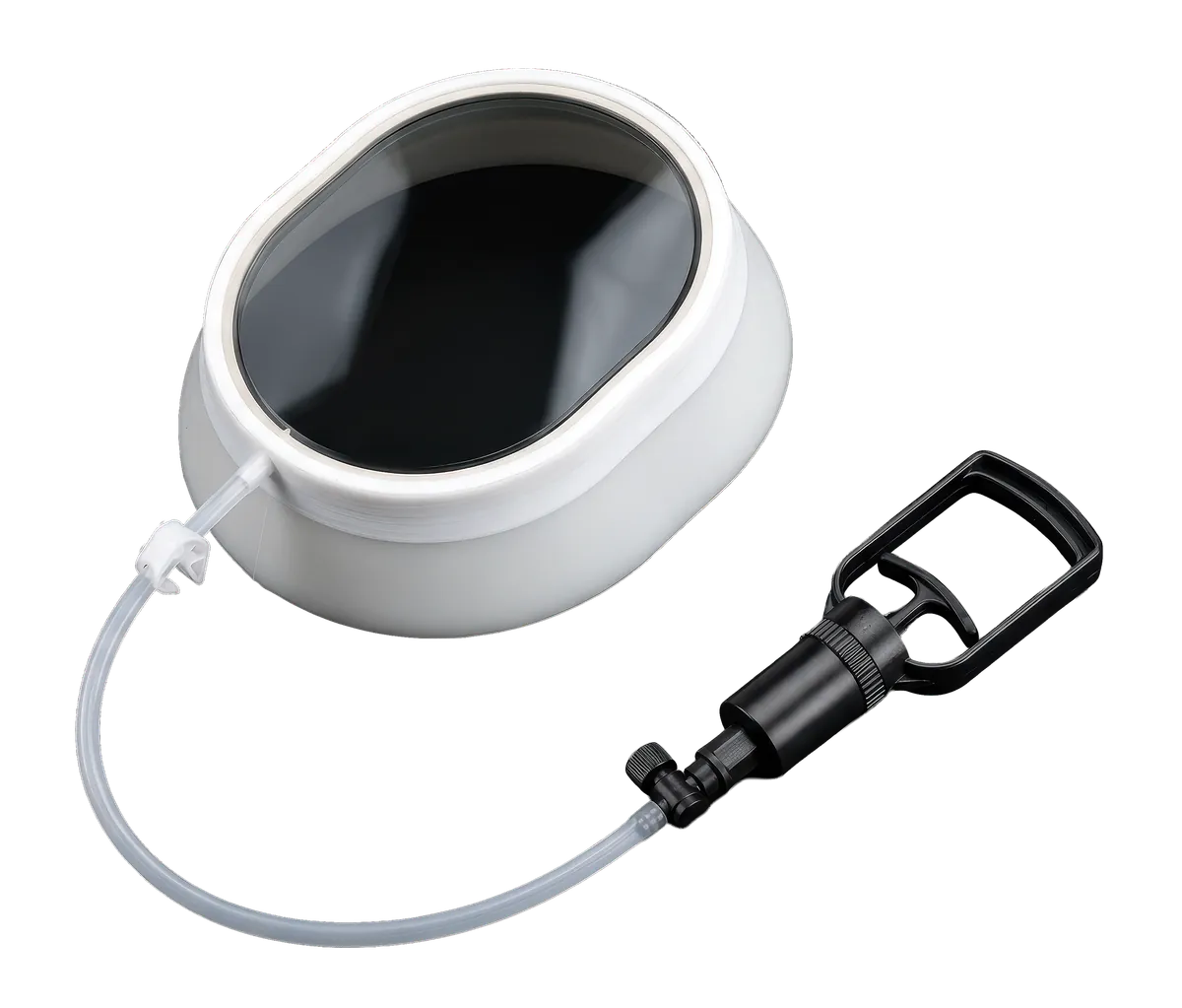
A bell sized to your chest and depth, with the session length and suction progression that decide whether it works.
- Cup sized to your chest, not a size chart
- Session length and pressure progression
- How to tell at 8 weeks if you are responding

This article is for educational purposes only and does not constitute medical advice. Always consult a qualified healthcare professional before starting any treatment protocol. View full disclaimer →